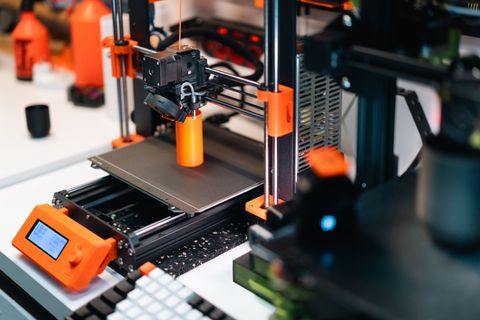
The process is also known as additive manufacturing. A digital model is converted into instructions that guide the printer as it deposits, cures, melts, or fuses material.
Depending on the machine, materials can include plastics, resins, metals, ceramics, composites, and specialized industrial materials.
A professional 3D printer can be used for detailed prototypes, engineering components, educational projects, and product development. Larger systems can support industrial production, where accuracy, repeatability, material performance, and process monitoring are important.
Common categories include:
Desktop 3D printers
Professional 3D printers
Industrial 3D printers
Resin-based printing systems
Filament-based printing systems
Metal 3D printing machines
Large-format additive manufacturing systems
Specialized manufacturing 3D printers
Automated 3D printing equipment
Why 3D Printing Matters Today
3D printing has become important because it allows manufacturers, engineers, researchers, designers, educational institutions, and medical organizations to create physical parts directly from digital models.
A major advantage is design flexibility. Complex shapes that may require several traditional manufacturing stages can sometimes be produced as a single printed component.
The technology can help address challenges such as:
Rapid prototyping
Complex component design
Customized product development
Small-batch manufacturing
Lightweight structures
Design testing
Replacement-part development
Educational experimentation
Distributed production
Reduced material waste in selected applications
An industrial 3D printer can also integrate with digital manufacturing systems, inspection equipment, computer-aided design software, and automated production workflows.
For engineering applications, the choice of machine depends on factors such as material, dimensional accuracy, production volume, part geometry, surface requirements, and post-processing needs.
How 3D Printing Technology Works
Although different printers use different processes, the general workflow is similar.
| Stage | Main Activity | Typical Output |
|---|---|---|
| Digital design | Create a 3D model | CAD file |
| Preparation | Convert model into print instructions | Sliced file |
| Material setup | Load or prepare printing material | Ready-to-print system |
| Printing | Build the object layer by layer | Physical part |
| Post-processing | Remove supports or finish surfaces | Refined component |
| Inspection | Check dimensions and quality | Approved or revised part |
The digital model is commonly divided into many thin layers by specialized software. The machine then follows these instructions to construct the object.
Different technologies use different methods. Fused filament systems melt thermoplastic material, while resin systems use light to cure liquid resin. Metal systems can use processes such as laser-based powder-bed fusion or directed-energy deposition.
Main Types of 3D Printing Machines
FDM and FFF printers use thermoplastic filament. They are widely used for prototypes, educational projects, mechanical concepts, fixtures, and general-purpose parts.
Resin printers use liquid photopolymer materials that are selectively cured using light. They can produce detailed objects and are commonly used for models, prototypes, dental applications, and small components.
SLA systems use a light source to cure resin with relatively high detail. They are useful where fine surface features are important.
SLS systems use powdered material and energy to create parts without relying on conventional support structures in the same way as many filament systems.
Metal 3D printing machines use specialized metal powders or wires. They are relevant to aerospace, automotive, medical, tooling, energy, and advanced engineering applications.
Large-format systems can produce substantially larger components and are used for industrial prototypes, tooling, construction-related experimentation, and other specialized applications.
3D Printing Equipment and Key Components
Modern 3D printing equipment includes much more than the printer itself. A complete workflow can include software, material handling, inspection, post-processing, and environmental controls.
Important components may include:
Print head or extrusion system
Build platform
Motion system
Heating system
Laser or light source
Material storage
Control electronics
Sensors
Printing software
Monitoring systems
Post-processing equipment
Measurement and inspection tools
Industrial environments may also use enclosed workspaces, automated material handling, robotic systems, quality-control equipment, and environmental monitoring.
The appropriate equipment depends strongly on the printing process. A metal system requires very different infrastructure from a desktop polymer printer.
3D Printing Automation
3D printing automation is becoming increasingly important as additive manufacturing moves toward larger production environments.
Automation can involve:
Automated material loading
Robotic part handling
Automated build removal
Machine monitoring
Production scheduling
Quality inspection
Digital inventory management
Automated post-processing
Data collection and analysis
The objective is generally to reduce repetitive manual steps and create more consistent workflows.
Connected machines can also generate production data that helps organizations monitor machine performance, identify process variations, and improve manufacturing planning.
Applications Across Different Industries
3D printing is now used across a broad range of fields.
In automotive manufacturing, it can support prototypes, fixtures, tooling, lightweight components, and design validation.
In aerospace, additive manufacturing can help create complex lightweight components and specialized parts where material efficiency and geometric freedom are important.
In healthcare, 3D printing can support anatomical models, dental applications, surgical planning, research, and certain customized medical products subject to applicable requirements.
In education, printers allow students to learn about computer-aided design, engineering, robotics, manufacturing, and product development through physical experimentation.
In architecture and construction, large-format printing is being explored for models, structures, and construction-related applications.
| Industry | Common Applications |
|---|---|
| Automotive | Prototypes, fixtures, tooling |
| Aerospace | Lightweight components, prototypes |
| Healthcare | Models, dental applications, research |
| Education | STEM learning, engineering projects |
| Architecture | Models and design visualization |
| Electronics | Enclosures, prototypes, components |
| Industrial manufacturing | Tooling, replacement parts, prototypes |
Recent Developments in India
India has continued to strengthen its additive manufacturing ecosystem during the past year.
On 13 March 2026, the Ministry of Electronics and Information Technology organized the second National Additive Manufacturing Symposium in New Delhi. The event brought together policymakers, researchers, industry participants, startups, and other stakeholders to discuss technology development, policy directions, and ecosystem growth.
India's National Strategy for Additive Manufacturing, introduced in February 2022, remains an important framework for developing the country's 3D printing ecosystem. The strategy focuses on areas including technology development, skills, research, startups, manufacturing capabilities, and deployment.
A Government of India update published on 7 October 2026 reported that the national strategy had trained more than 154,000 individuals and supported 56 additive-manufacturing startups. The same update described a move toward NSAM 2.0, with greater emphasis on advanced manufacturing, research, international cooperation, defense applications, and sustainability-oriented projects.
The Ministry of Electronics and Information Technology's 2025–26 annual report also highlights the National Centre for Additive Manufacturing and its work involving research, standards, technology access, product development, and skill development.
Laws, Policies, and Government Programs in India
3D printing in India is affected by several layers of regulation rather than one universal 3D printing law.
The National Strategy for Additive Manufacturing provides the main policy direction for developing the country's additive manufacturing ecosystem. It was formally released by MeitY on 24 February 2022.
Depending on the application, manufacturers may also need to consider:
Product safety requirements
Intellectual-property rights
Industrial safety rules
Environmental requirements
Material handling regulations
Sector-specific standards
Medical-device regulations
Aerospace or defense requirements
Import and export controls where applicable
For example, a prototype used only for internal design testing may face different regulatory considerations from a component intended for a medical, aerospace, automotive, or defense application.
Organizations should therefore identify the intended application and applicable standards before placing a 3D-printed component into a regulated environment.
Government initiatives are also supporting additive manufacturing through development centers, research programs, skill development, and ecosystem-building activities. India has established specialized development and deployment centers to strengthen research and practical access to additive manufacturing technologies.
Tools and Resources for 3D Printing
Several categories of software and equipment can support a 3D printing workflow.
CAD software: Used to create three-dimensional engineering or product designs.
Slicing software: Converts a 3D model into machine instructions and allows users to configure parameters such as layer height, infill, supports, and printing speed.
3D modeling platforms: Useful for creating artistic, educational, mechanical, and architectural models.
Material databases: Provide information about polymers, resins, metals, composites, and their relevant characteristics.
Machine monitoring platforms: Help track printer status, production activity, temperatures, and selected machine parameters.
3D printer diagnostic tools: Can assist with calibration, alignment, temperature checks, extrusion analysis, and other routine troubleshooting tasks.
Additive manufacturing research resources: Government institutions, universities, industry organizations, and specialized development centers can provide technical information and educational material.
Choosing the Right 3D Printer
The most appropriate machine depends on the intended application rather than simply the printer's size or advertised specifications.
Consider these factors:
Material requirements
Required dimensional accuracy
Part size
Surface quality
Production volume
Printing speed
Environmental requirements
Software compatibility
Post-processing requirements
Operator skill level
Safety requirements
A professional 3D printer may be appropriate for engineering development and detailed prototyping, while an industrial 3D printer may be better suited to continuous manufacturing environments.
A metal 3D printing machine requires additional consideration of powder or wire handling, process monitoring, ventilation, post-processing, and material qualification.
Frequently Asked Questions
What is a 3D printing machine?
A 3D printing machine is equipment that creates physical objects from digital three-dimensional designs, usually by constructing the object layer by layer.
What is the difference between a professional and industrial 3D printer?
A professional 3D printer is generally designed for advanced prototyping, design, engineering, education, or specialized production. An industrial 3D printer is typically designed for demanding manufacturing environments with greater emphasis on repeatability, process monitoring, materials, and production integration.
What is a metal 3D printing machine used for?
Metal 3D printing machines can produce complex metal components for applications such as aerospace, automotive engineering, medical technology, tooling, energy, and research. The specific suitability depends on the printing process and material.
Can 3D printing replace traditional manufacturing?
Not universally. 3D printing is particularly useful for complex geometries, prototypes, customized components, and selected production applications. Traditional manufacturing remains important for many high-volume and established production processes.
What software is needed for 3D printing?
A typical workflow may require CAD or modeling software to create the design and slicing software to convert that design into instructions for the printer. Industrial workflows may also use simulation, monitoring, inspection, and production-management software.
Conclusion
3D printing machines have developed from specialized prototyping equipment into an important part of modern 3D printing technology and digital manufacturing.
The field now includes desktop systems, professional machines, industrial 3D printers, metal 3D printing machines, automated production equipment, and specialized additive manufacturing platforms.
Its importance comes from the ability to transform digital designs into physical components while supporting complex geometries, rapid design iteration, customization, and selected forms of distributed manufacturing.
India is also strengthening its additive manufacturing ecosystem. The National Strategy for Additive Manufacturing, National Additive Manufacturing Symposium, development centers, research programs, and NSAM 2.0 direction demonstrate continued government attention to this technology.
For anyone exploring 3D printing equipment, the most useful starting point is to understand the intended application, material, machine technology, software workflow, safety requirements, and relevant regulations. This provides a practical foundation for evaluating how additive manufacturing can fit into education, product development, engineering, research, or industrial production.