Artificial Intelligence in Education: Explore Guide, Tips, Insights, Advice, and Expert Suggestions
Artificial intelligence in education refers to the use of AI technologies to support teaching, learning, assessment, educational administration, and access to learning resources.
AI systems can analyze information, generate content, identify patterns, provide feedback, translate material, and support personalized learning activities. Depending on how they are designed, they can be used by students, teachers, schools, colleges, universities, researchers, and education administrators.
AI in education does not necessarily mean replacing teachers with technology. In many educational settings, AI is better understood as an additional tool that can support human-led teaching and learning.
Examples include:
Personalized practice questions
Automated feedback
Language-learning assistance
Educational content generation
Accessibility features
Learning analytics
Research assistance
Administrative support
Question-answer systems
Curriculum-related resource development
An AI tutoring system can provide explanations, practice activities, hints, and feedback based on a learner's interaction with the system. However, its responses should be reviewed carefully because AI systems can generate inaccurate or incomplete information.
Why AI in Education Matters Today
Education systems face several challenges, including large student populations, different learning speeds, language diversity, teacher workload, accessibility requirements, and the need to develop digital skills.
AI can potentially support some of these challenges when implemented appropriately.
For students, AI can provide additional opportunities to practice concepts or explore explanations. For teachers, it can assist with routine preparation and administrative activities.
UNESCO's AI competency framework for students emphasizes a human-centred mindset, AI ethics, AI techniques and applications, and AI system design. It organizes these competencies across the progression levels of understanding, applying, and creating.
A balanced educational approach therefore focuses not only on using AI, but also on teaching students how to question, evaluate, and understand AI-generated information.
Major Applications of AI in Education
AI applications can be grouped according to the educational task they support.
| Application | Possible Educational Use |
|---|---|
| AI tutoring system | Explanations, hints, practice and feedback |
| AI learning tools | Personalized exercises and study support |
| AI education tools | Content creation and classroom activities |
| AI teaching assistant | Lesson preparation and administrative support |
| Language AI | Translation, writing and language practice |
| Learning analytics | Identifying learning patterns |
| Accessibility AI | Support for different learning needs |
| Generative AI | Drafting educational materials and examples |
| Assessment tools | Question generation and feedback support |
| Research tools | Information organization and literature exploration |
The usefulness of any particular system depends on its design, subject area, age group, data practices, and the level of human oversight.
AI Tutoring Systems and Personalized Learning
An AI tutoring system is designed to interact with learners and provide support during educational activities.
A basic system may provide a question and evaluate an answer. More advanced systems can adjust the difficulty or provide different explanations based on previous interactions.
A simplified learning cycle can be represented as:
Learning activity → Student response → AI analysis → Feedback → Additional practice → Teacher review
Personalization can be useful because students do not always progress at the same pace. However, personalization should not be treated as a guarantee of improved academic performance.
Teachers remain important for understanding student motivation, context, emotional development, classroom relationships, and learning difficulties that automated systems may not adequately recognize.
UNESCO's teacher framework emphasizes that AI should complement, rather than replace, the essential role and responsibilities of teachers.
AI Learning Tools for Students
AI learning tools can support students in different ways.
Common applications include:
Generating practice questions
Explaining difficult concepts
Creating study outlines
Supporting language practice
Summarizing supplied learning material
Providing alternative explanations
Creating flashcards
Organizing notes
Supporting brainstorming
Helping students examine different approaches to a problem
Students should distinguish between using AI to understand a subject and simply obtaining an answer.
A stronger learning process is to ask AI for an explanation, attempt the problem independently, compare the reasoning, and then verify important facts through textbooks, teachers, academic resources, or official sources.
AI Education Tools for Teachers
Teachers can use AI education tools for selected preparation and administrative activities.
Potential uses include:
Drafting lesson-plan ideas
Generating question variations
Creating reading-level adaptations
Preparing discussion prompts
Developing classroom examples
Organizing learning activities
Translating educational material
Creating preliminary rubrics
Summarizing teacher-provided information
Preparing differentiated exercises
AI-generated educational material should be reviewed before classroom use.
This is particularly important for factual subjects, because generative AI can produce plausible but incorrect statements.
UNESCO's teacher competency framework recommends that educators develop the ability to critically assess AI outputs and understand the interaction between AI, teaching, learning, and assessment.
AI-Powered Learning Platforms
An AI powered learning platform may combine several AI capabilities within a single educational environment.
Depending on the platform, features can include:
Personalized learning paths
Automated recommendations
Interactive tutoring
Progress dashboards
Content generation
Adaptive assessments
Language support
Learning analytics
Accessibility features
When evaluating such a platform, institutions should look beyond the number of AI features.
Important questions include:
What educational problem does the system address?
What information does it collect?
How is student data handled?
Can teachers review AI-generated recommendations?
How are errors reported?
Can students understand why a recommendation was made?
Is the system suitable for the learners' age group?
Does it work with the existing curriculum?
AI Teaching Assistants
An AI teaching assistant can help with selected repetitive activities, but it should generally operate under teacher supervision.
For example, it might help prepare a preliminary list of discussion questions or organize information supplied by a teacher.
It should not independently make high-impact decisions about a student's educational future without appropriate human review.
UNESCO's framework describes teachers as designers and facilitators of AI-supported learning and emphasizes human agency, accountability, and ethical use.
This distinction is important because educational decisions can affect assessment, progression, inclusion, and student opportunities.
Recent Developments in India
India has been moving toward earlier exposure to artificial intelligence and computational thinking in school education.
On 1 April 2026, the Ministry of Education announced the launch of the CBSE curriculum on Computational Thinking and Artificial Intelligence for Classes III to VIII. The initiative is aligned with NEP 2020 and the National Curriculum Framework for School Education 2023.
The development followed a stakeholder consultation held on 29 October 2025, involving organizations including CBSE, NCERT, KVS, NVS, and external experts. The Ministry stated that AI and computational thinking would be introduced from Grade 3 beginning with the 2026–27 academic session.
The initiative also includes teacher-training and educational-resource development, showing that AI education is being considered as both a student-learning topic and a teacher-capability requirement.
At the international level, UNESCO's AI competency frameworks for students and teachers continue to provide reference points for responsible AI literacy. The student framework contains 12 competencies across four dimensions, while the teacher framework covers five areas including AI foundations, ethics, pedagogy, and professional learning.
Risks and Limitations of AI in Education
AI can provide useful educational support, but it also introduces risks.
Important concerns include:
Incorrect or fabricated information
Student-data privacy
Algorithmic bias
Overdependence on automated answers
Reduced independent thinking
Unequal access to technology
Inappropriate use for assessments
Copyright and attribution questions
Lack of transparency
Inadequate teacher oversight
UNESCO specifically identifies risks involving human agency, privacy, discrimination, inequality, and the possibility that excessive automation could weaken meaningful teacher-student relationships.
A responsible implementation should therefore combine AI capabilities with human judgment, verification, clear institutional policies, and appropriate digital-literacy education.
Laws and Policies Affecting AI in Education in India
AI used in education can involve substantial amounts of personal information, particularly when platforms maintain student profiles, learning histories, assessment results, or behavioral information.
India's Digital Personal Data Protection Act, 2023 contains specific provisions concerning children's personal data. Section 9 requires verifiable parental or guardian consent before processing a child's personal data, subject to the Act's provisions and prescribed exceptions. It also restricts processing that is likely to have a detrimental effect on a child's well-being and prohibits tracking or behavioral monitoring of children and targeted advertising directed at children, subject to specified exceptions.
The government notified the Digital Personal Data Protection Rules, 2025 on 13 November 2025, with a phased commencement structure.
MeitY's current information also records the establishment of the Data Protection Board of India and the phased implementation framework associated with the Rules.
For educational institutions, this makes data governance an important consideration when adopting AI platforms.
Institutions should examine:
What student information is collected
Why it is collected
How consent is handled
Where data is stored
Who can access it
How long information is retained
Whether students' information is used for secondary purposes
How security incidents are handled
Tools and Useful Resources
Several educational resources can support responsible AI learning.
CBSE and NCERT resources: Useful for curriculum-aligned school education and AI-related learning materials. The Ministry of Education announced the 2026 curriculum for Classes III–VIII as part of India's AI and computational-thinking education initiative.
UNESCO AI competency frameworks: Useful for understanding AI competencies for students and teachers, including ethics, AI foundations, pedagogy, and responsible use.
Rashtriya e-Pustakalaya: India's digital library initiative provides access to educational books and other digital reading resources across languages and age groups.
AI-use classroom checklist: Teachers can create a checklist covering source verification, student privacy, permitted AI use, attribution, and human review.
AI-output verification worksheet: Students can record an AI-generated claim, identify the source used to verify it, and explain whether the original output was accurate.
Practical Guidelines for Responsible AI Use
A useful classroom framework is:
Use AI → Check AI → Discuss AI → Apply independently
Teachers and students can follow several practical principles:
Treat AI output as information to evaluate, not unquestionable fact.
Verify important claims with reliable sources.
Avoid entering unnecessary personal information.
Keep teachers involved in important learning decisions.
Use AI to support understanding rather than bypass learning.
Explain when AI has been used for an assignment where institutional rules require disclosure.
Check generated material for bias and inappropriate content.
Maintain human interaction and discussion.
Consider accessibility and language needs.
Review institutional AI policies before using external platforms.
A simple comparison can help clarify appropriate use:
| Appropriate Use | Caution Required |
|---|---|
| Generating practice questions | Automated grading |
| Explaining a concept | Making academic progression decisions |
| Brainstorming ideas | Diagnosing learning difficulties |
| Language practice | Handling sensitive student information |
| Draft lesson ideas | Replacing teacher judgment |
| Study organization | Submitting AI output as independent work |
Frequently Asked Questions
What is artificial intelligence in education?
It is the use of AI technologies to support teaching, learning, assessment, accessibility, educational research, or administration. Applications can include tutoring, content generation, learning analytics, and personalized practice.
What is an AI tutoring system?
An AI tutoring system is an educational application that can interact with learners, provide explanations, generate practice activities, and give feedback. Its responses should still be reviewed because AI can make errors.
Can AI replace teachers?
AI can assist with selected teaching and administrative activities, but it does not replace the broader role of teachers. Human judgment, classroom relationships, mentorship, contextual understanding, and educational accountability remain important.
Are AI learning tools safe for children?
Safety depends on the specific tool, its data practices, age suitability, security controls, and institutional policies. India's data-protection framework contains specific provisions concerning children's personal data, including requirements related to verifiable parental or guardian consent.
How should students use AI responsibly?
Students should use AI as a learning aid, verify important information, protect personal data, follow school or college rules, and maintain independent thinking rather than relying entirely on generated answers.
Conclusion
Artificial intelligence in education is developing from an experimental technology into a broader educational capability involving students, teachers, institutions, curriculum designers, and policymakers.
AI tutoring systems, AI learning tools, AI education tools, AI-powered learning platforms, and AI teaching assistants can support activities such as personalized practice, content preparation, accessibility, feedback, and educational administration.
At the same time, responsible adoption requires attention to accuracy, privacy, bias, transparency, academic integrity, and human oversight. UNESCO's competency frameworks emphasize that AI literacy should include technical understanding as well as ethics, human agency, and responsible use.
India's launch of the CBSE Computational Thinking and Artificial Intelligence curriculum for Classes III–VIII on 1 April 2026 represents an important recent development in school-level AI education. The country's data-protection framework also makes responsible handling of student information an important consideration.
The most practical approach is therefore not simply to introduce more AI tools, but to use them thoughtfully, verify their outputs, protect learner information, and keep educators and students at the center of the learning process.
Disclaimer: This article is provided for general informational and educational purposes only. It does not make any guarantee, claim, or professional recommendation regarding any AI tool, platform, educational institution, policy, or technology discussed. The information may change as technology, regulations, and educational policies develop. Readers should verify current requirements with the relevant government authorities, educational institutions, or qualified professionals before making decisions. This article is not intended to sell, promote, or endorse any product, platform, or organization.

Related Post...

Online Learning Platforms: Complete Guide to Basics, Techniques, Facts, Knowledge, and Best Practices
Updated: November 02, 2026
Read More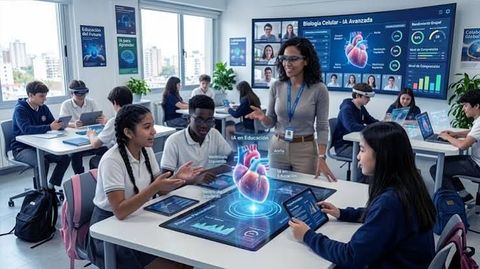
Artificial Intelligence in Education: Explore Guide, Tips, Insights, Advice, and Expert Suggestions
Updated: November 02, 2026
Read More
Digital Marketing Courses: Complete Guide to Basics, Techniques, Facts, Knowledge, and Best Practices
Updated: November 02, 2026
Read More