Modern automated food packaging equipment can combine several operations into one production workflow. This helps food manufacturers maintain more consistent package sizes, sealing conditions, and production processes.
A typical automated packaging sequence may look like:
Product preparation → Filling → Package forming → Sealing → Coding → Inspection → Conveying → Secondary packaging
The exact configuration depends on the product characteristics, packaging material, package size, and production requirements.
Why Automatic Packaging Equipment Matters Today
Food production has become increasingly dependent on consistent handling and packaging. Manual packaging can involve repetitive weighing, filling, sealing, and checking activities. Automation can coordinate these steps and reduce unnecessary variation.
Industrial food packaging machines are particularly relevant where production involves large quantities or multiple packaging formats.
They can help address several practical challenges:
Maintaining consistent fill quantities
Reducing repetitive manual handling
Improving packaging-line coordination
Supporting hygienic production environments
Maintaining consistent sealing parameters
Recording production information
Integrating inspection equipment
Handling different package formats
Improving workflow visibility
Automation does not eliminate the need for trained operators. Instead, people generally remain responsible for machine setup, quality checks, material handling, sanitation, troubleshooting, and process monitoring.
Main Types of Automatic Food Packaging Machines
Different food products require different packaging technologies. There is no single machine configuration suitable for every product.
| Machine Type | Typical Application | Main Function |
|---|---|---|
| Automatic filling machine | Powders, liquids, grains, snacks | Measures and fills products |
| Automatic sealing machine | Pouches, trays, containers | Creates package seals |
| Form-fill-seal machine | Flexible pouches | Forms, fills, and seals packaging |
| Weighing machine | Grains, pulses, snacks | Measures product by weight |
| VFFS machine | Snacks, spices, powders | Creates vertical pouches |
| HFFS machine | Ready foods and specialty packs | Creates horizontal packages |
| Vacuum packaging machine | Meat, cheese, prepared foods | Removes air before sealing |
| Tray sealing machine | Prepared foods and fresh products | Seals products in trays |
| Labeling equipment | Bottles, containers, cartons | Applies product labels |
| Coding machine | Most packaged foods | Prints dates, batches, and codes |
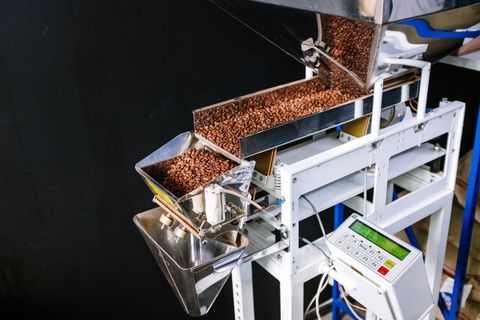
An automatic filling and sealing machine combines two important stages. It may be configured for liquids, powders, granules, or other food products depending on its dosing mechanism.
An automatic food sealing machine, by comparison, focuses mainly on closing and sealing containers or flexible packaging.
Important Features to Understand
When examining an automatic food packaging machine, specifications should be evaluated according to the complete production requirement rather than one performance figure.
Important characteristics include:
Filling accuracy
Packaging speed
Product compatibility
Package dimensions
Sealing temperature control
Machine construction
Control-panel interface
Sensor systems
Safety mechanisms
Cleaning and sanitation access
Changeover requirements
Compatibility with upstream and downstream equipment
For food applications, hygienic design is especially important. Surfaces that come into contact with food should be appropriate for the intended application, and machine design should allow practical cleaning and inspection.
Choosing Equipment for Different Food Products
Food characteristics strongly influence machine selection.
Dry powders may require auger-based dosing, while grains and snacks can use volumetric or multihead weighing systems. Liquids often require pumps or other controlled filling mechanisms.
Sticky, fragile, irregular, or temperature-sensitive products can require specialized handling.
A useful evaluation framework is:
| Requirement | Questions to Consider |
|---|---|
| Product | Is it liquid, powder, granular, solid, or fragile? |
| Package | Pouch, bottle, tray, carton, jar, or another format? |
| Quantity | What fill range is required? |
| Production | What throughput is appropriate? |
| Hygiene | What cleaning and food-contact requirements apply? |
| Integration | Can the equipment connect to conveyors, checkweighers, or inspection systems? |
| Flexibility | How many package sizes must be handled? |
| Controls | What sensors, PLCs, and monitoring features are needed? |
Recent Developments in Food Packaging Automation
Food packaging technology is increasingly moving toward connected, data-driven, and resource-efficient systems.
The Ministry of Food Processing Industries identifies AI, IoT, robotics, smart processing, and energy-efficient technologies among important developments in modern food-processing systems. Its technology focus also highlights active packaging, intelligent packaging, smart labels, and traceability technologies.
These developments influence packaging machinery in several ways.
Modern systems may increasingly incorporate:
Digital production monitoring
Automated fault detection
Sensor-based quality checks
Machine connectivity
Recipe-based changeovers
Vision inspection
Data collection
Robotic product handling
Energy monitoring
Improved packaging-material efficiency
In 2026, sustainability is also becoming more closely connected with packaging design. Equipment may need to accommodate lighter films, recyclable structures, or alternative packaging materials while maintaining reliable sealing and product protection.
Recent Indian Food-Processing Developments
India's food-processing ecosystem continues to receive government attention. The Ministry of Food Processing Industries currently lists initiatives including PMKSY, PMFME, and the Production Linked Incentive Scheme for Food Processing Industry.
The PMFME framework includes support for upgrading micro food-processing units and common infrastructure. Its current portal describes credit-linked capital support for eligible units and common infrastructure projects, subject to scheme conditions.
For businesses evaluating automation, this broader policy environment is relevant because packaging equipment can form part of a food-processing modernization project.
Understanding Market Pricing Without Relying on One Figure
Searches for automatic food packaging machine price can produce widely different figures because machine configurations vary substantially.
Instead of relying on one advertised number, compare the underlying specifications.
Factors influencing market pricing include:
Machine capacity
Filling technology
Automation level
Number of packaging stations
Packaging material
Control system
Inspection equipment
Product-contact construction
Number of package formats
Integration requirements
A basic sealing unit and a complete automated packaging line are fundamentally different pieces of equipment, so their financial requirements should not be compared as though they were equivalent.
Automatic Food Packaging Machine Suppliers and Manufacturers
When researching an automatic food packaging machine supplier or food packaging machine manufacturer, technical documentation is more useful than promotional claims alone.
Look for information such as:
Machine specifications
Compatible product categories
Package-size ranges
Electrical requirements
Installation requirements
Cleaning procedures
Operating manuals
Safety documentation
Food-contact material information
Spare-part documentation
Training information
A potential food packaging machine manufacturer should also be evaluated according to the equipment's compatibility with the intended production environment.
Independent technical evaluation is particularly important for complex food packaging line equipment, where several machines need to communicate and operate together.
Laws and Policies Affecting Food Packaging in India
Food packaging machinery itself is only one part of regulatory compliance. The packaged food, packaging material, labeling, and food-production process may all be subject to different requirements.
The Food Safety and Standards Authority of India maintains the Food Safety and Standards (Packaging) Regulations, 2018, which address packaging materials intended for food applications. The regulations distinguish primary packaging, which comes into direct contact with food, from secondary packaging.
This means packaging equipment should be selected with the intended packaging material and food-contact application in mind.
FSSAI also continued updating its regulatory framework during 2026. For example, a Packaging Amendment Regulation concerning the list of packaging materials for pan masala was finalized on 10 August 2026.
Additional FSSAI amendments during 2026 addressed licensing, labeling, contaminants, laboratory procedures, and other food-safety matters.
Food businesses should therefore verify the latest applicable FSSAI requirements rather than relying solely on older machinery documentation.
Useful Tools and Resources
Several resources can help when researching packaging automation.
FSSAI: Useful for food-safety regulations, packaging requirements, notifications, and compliance information.
Ministry of Food Processing Industries: Provides information on food-processing schemes, technology developments, infrastructure programs, and policy initiatives.
PMFME Portal: Relevant to micro food-processing enterprises and eligible modernization or infrastructure initiatives.
Machine specification checklist: A simple spreadsheet can compare filling range, package dimensions, speed, electrical requirements, materials, controls, and integration requirements.
Packaging-material compatibility chart: Useful for recording which films, laminates, trays, bottles, or containers are compatible with each machine.
Production calculation sheet: Can compare required output with machine capacity while accounting for changeovers, cleaning, downtime, and quality checks.
Practical Checklist Before Selecting Equipment
Before selecting an automated packaging system, consider the complete workflow rather than the machine alone.
Identify the food product characteristics.
Define package type and dimensions.
Determine the required filling range.
Review expected production volumes.
Check food-contact material requirements.
Examine cleaning and sanitation procedures.
Evaluate sealing requirements.
Consider coding and labeling needs.
Check compatibility with conveyors and inspection equipment.
Review electrical and environmental requirements.
Examine operator-safety features.
Verify documentation and applicable standards.
Consider future packaging-format changes.
This approach can help prevent a situation where one machine performs well individually but does not integrate properly with the rest of the production line.
Frequently Asked Questions
What is an automatic food packaging machine?
It is equipment that performs one or more packaging operations with limited manual intervention. Depending on the configuration, it can fill, form, seal, label, code, inspect, or transfer food packages.
What is the difference between an automatic filling and sealing machine and a sealing machine?
An automatic filling and sealing machine performs both product filling and package sealing. An automatic food sealing machine primarily focuses on closing and sealing an already filled container or package.
Are automatic packaging machines suitable for small food businesses?
Some compact systems can be appropriate for smaller production environments, while larger systems are designed for industrial operations. The appropriate configuration depends on product type, packaging format, production volume, available space, and regulatory requirements.
What should be checked before selecting food packaging machinery?
Important considerations include product characteristics, packaging material, fill range, package dimensions, machine capacity, hygiene requirements, cleaning access, safety systems, controls, and compatibility with other equipment.
Are food packaging machines affected by Indian food regulations?
Yes. Although machinery and food regulations are not identical, the equipment and packaging process need to support compliance with applicable food-safety and packaging requirements. FSSAI's Packaging Regulations address materials used for food packaging, including food-contact applications.
Conclusion
Automatic food packaging machines are an important part of modern food-processing operations. They can combine filling, sealing, coding, inspection, conveying, and other activities into coordinated packaging workflows.
The best equipment choice depends on the food product, packaging material, required output, hygiene requirements, available space, and level of automation.
Current developments are moving toward connected machinery, sensor-based monitoring, robotics, intelligent packaging, and more resource-efficient production. India's food-processing policy environment is also evolving, with government programs supporting modernization and infrastructure across the sector.
For anyone researching automatic food packaging machines, focusing on specifications, regulatory requirements, packaging compatibility, and complete-line integration provides a more reliable basis for understanding the technology than relying on a single machine specification or headline figure.