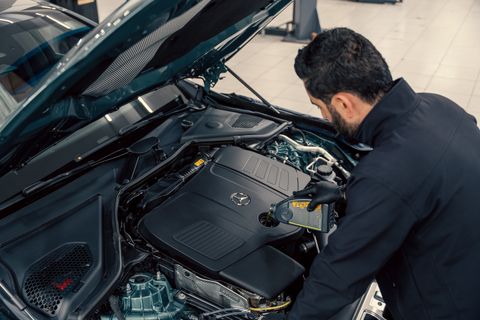
Regular maintenance can involve both traditional vehicle checks and EV-specific inspections. Tires, brakes, suspension, lights, steering, windshield systems, and cabin components still require attention. At the same time, technicians may need to inspect battery condition, charging components, thermal-management systems, electrical connections, and electronic control systems.
An EV maintenance program may include:
Battery health monitoring
High-voltage system inspection
Brake and tire checks
Cooling-system inspection
Charging-port examination
Software and diagnostic checks
Suspension and steering inspection
Cabin-filter replacement
Electrical-system testing
The exact maintenance schedule depends on the vehicle manufacturer, model, battery technology, driving conditions, climate, and mileage.
Why EV Maintenance Matters
Electric vehicles contain high-voltage electrical systems that require appropriate knowledge and equipment. Routine inspection can help identify developing problems before they affect vehicle operation.
EV maintenance is relevant to private vehicle owners, fleet operators, technicians, charging-site operators, manufacturers, and businesses working with electric mobility.
One important difference between EVs and conventional vehicles is the drivetrain. EVs generally have fewer moving drivetrain components, which can reduce some routine mechanical maintenance requirements. However, this does not mean an EV requires no maintenance.
Battery condition is particularly important because the battery pack is a major component of the vehicle. Temperature, charging patterns, age, driving conditions, and battery-management software can influence battery performance over time.
Common maintenance areas include:
Battery condition and thermal management
Brake-system inspection
Tire wear and alignment
Charging equipment
Electrical connections
Cooling systems
Suspension components
Software diagnostics
High-voltage safety systems
For an electric car repair, technicians must understand the difference between low-voltage vehicle electronics and high-voltage propulsion systems. High-voltage components should be handled only by appropriately trained personnel following manufacturer and workplace safety procedures.
Key EV Maintenance Areas
Battery inspection is one of the most important parts of EV maintenance. Battery-management systems continuously monitor parameters such as temperature, voltage, and state of charge. Diagnostic equipment can help identify abnormal conditions.
EV battery repair is a specialized activity. Depending on the vehicle and manufacturer, a battery problem may involve software, electrical connections, cooling components, individual modules, or the complete battery assembly. Not every battery issue can or should be addressed through individual-cell repair.
Brake maintenance remains important even though regenerative braking can reduce the use of conventional friction brakes. Brake components can still experience corrosion, wear, or other issues.
Tire maintenance is also significant. EVs can have substantial vehicle weight because of the battery pack, and electric motors can deliver immediate torque. Correct tire pressure, alignment, and suitable tires are therefore important for handling and efficiency.
Thermal management helps maintain appropriate temperatures for the battery, motor, and power electronics. A cooling-system problem can affect performance and, depending on the vehicle, charging capability.
EV Diagnostics and Maintenance Equipment
Modern EVs rely heavily on electronic control systems. EV diagnostics can involve scanning vehicle control modules, reading fault codes, checking battery parameters, examining charging behavior, and analyzing system data.
Professional electric vehicle service equipment can include:
Insulated hand tools
High-voltage testing equipment
Diagnostic scanners
Insulation-resistance testers
Battery test equipment
Personal protective equipment
Voltage detection devices
Vehicle lifting equipment
Thermal imaging equipment
Battery handling equipment
EV maintenance tools should be appropriate for the vehicle and voltage system being examined. Ordinary workshop equipment is not automatically suitable for high-voltage EV work.
A simplified diagnostic workflow can look like this:
| Maintenance Stage | Main Activity | Purpose |
|---|---|---|
| Initial inspection | Visual and system checks | Identify obvious issues |
| Diagnostic scan | Read electronic systems | Identify stored faults |
| Battery assessment | Review battery parameters | Evaluate battery condition |
| Charging inspection | Check charging equipment | Identify charging problems |
| Mechanical inspection | Examine brakes, tires, suspension | Maintain roadworthiness |
| Repair or adjustment | Address identified problems | Restore appropriate operation |
| Verification | Recheck systems | Confirm the issue has been addressed |
EV Charging and Home Charging Considerations
Charging equipment is another important part of EV ownership. Electric vehicle charging solutions range from standard household charging to dedicated AC wall-mounted equipment and high-power DC charging infrastructure.
The appropriate charging setup depends on the vehicle, electrical supply, parking arrangement, charging requirements, and applicable electrical regulations.
A home charging installation should generally involve assessment of:
Available electrical capacity
Wiring and protective devices
Earthing arrangements
Charger compatibility
Cable routing
Outdoor weather protection where applicable
Electrical safety requirements
Local utility requirements
The term EV charger installation cost is frequently searched online, but the actual amount can vary substantially according to charger type, electrical upgrades, installation conditions, location, and applicable taxes or regulatory requirements. Because these factors change between properties and regions, a general figure should not be treated as a universal estimate.
Recent EV Maintenance and Charging Developments
India's EV ecosystem has continued to expand during 2025 and 2026, with government programs focusing on charging infrastructure and electric mobility.
The Ministry of Power issued its Guidelines for Installation and Operation of Electric Vehicle Charging Infrastructure-2024 on 17 September 2024. The guidelines apply to private, semi-restricted, and public charging locations as well as highways and expressways. They also address electricity connections, charging infrastructure standards, and network development.
In January 2025, the Ministry of Power also issued guidelines concerning battery swapping and charging stations. These developments are relevant to maintenance because EV charging and battery-related infrastructure require appropriate technical standards and operational procedures.
On 26 September 2025, the Ministry of Heavy Industries issued operational guidelines for deploying public EV charging stations under the PM E-DRIVE program. The program includes infrastructure support for public charging stations and establishes implementation procedures.
More recently, on 21 July 2026, the Government of India reported 52,718 public charging stations, including 16,561 public charging stations equipped with fast chargers for cars, based on information from the BHEL portal.
In May 2026, the Ministry of Heavy Industries announced approval of proposals involving 1,243 EV chargers in Karnataka and stated that proposals worth ₹503.86 crore had been approved for 4,874 chargers through various states and Central Public Sector Enterprises.
These developments indicate that maintenance planning increasingly needs to consider not only the vehicle but also the charging environment.
EV Laws, Policies, and Regulations in India
India's EV maintenance landscape is influenced by national policies, electricity regulations, environmental rules, vehicle standards, and state-level EV policies.
The Ministry of Power's 2024 charging guidelines are particularly relevant to charging infrastructure. They establish standards and protocols intended to create a connected and interoperable charging network. The guidelines also allow residential owners to use existing electricity connections for EV charging, subject to applicable requirements.
The guidelines state that EV charging stations are not treated as a licensed electricity distribution activity. Government information published in 2025 also confirmed that establishing EV charging stations is an unlicensed activity, subject to applicable technical and regulatory requirements.
The PM E-DRIVE Scheme, notified in September 2024, has supported India's electric-mobility ecosystem. Its original framework included ₹2,000 crore for public EV charging infrastructure, alongside other components covering electric mobility and vehicle testing infrastructure.
State governments may have additional EV policies concerning registration, charging infrastructure, electricity connections, parking, or other aspects of electric mobility. Therefore, requirements can vary according to the location of the vehicle or charging installation.
Useful EV Maintenance Tools and Resources
Several resources can help EV owners and technicians understand maintenance requirements.
Manufacturer manuals: Vehicle manufacturers provide model-specific maintenance schedules, charging instructions, warning indicators, battery information, and safety procedures. These should be treated as the primary reference for vehicle-specific maintenance.
Diagnostic equipment: Appropriate diagnostic scanners can identify electronic fault codes and provide information from vehicle control systems. Compatibility varies between manufacturers and models.
Battery monitoring systems: Battery-management information can help technicians evaluate parameters such as voltage, temperature, state of charge, and diagnostic warnings.
Charging applications: Many charging networks provide applications that display charger locations, connector types, operating status, and other relevant information.
Ministry of Power resources: Official government documents provide information about India's EV charging infrastructure guidelines and technical framework.
PM E-DRIVE resources: The official PM E-DRIVE portal publishes scheme guidelines, operational documents, FAQs, and related policy updates.
Maintenance records: Keeping a digital record of inspections, warning messages, charging issues, tire changes, software updates, and repairs can make long-term vehicle maintenance easier to track.
Frequently Asked Questions
How often does an electric vehicle need maintenance?
There is no single schedule for every EV. Maintenance intervals depend on the manufacturer, model, mileage, operating conditions, and vehicle age. The manufacturer's maintenance schedule should be followed for the specific vehicle.
Does an EV need battery maintenance?
The battery pack generally does not require routine mechanical maintenance in the same way as an engine. However, battery-management systems, cooling systems, electrical connections, charging behavior, and diagnostic information may need periodic inspection.
Can an EV battery be repaired?
Some battery-related problems can be addressed through specialized diagnostic and repair procedures, depending on the vehicle design and manufacturer guidance. Other problems may require replacement of a module or larger battery assembly. High-voltage battery work requires appropriate training and safety procedures.
What is EV diagnostics?
EV diagnostics is the process of examining electronic control systems and vehicle data to identify faults or abnormal operating conditions. It can include diagnostic-code analysis, battery-system checks, charging-system tests, and electronic-system evaluation.
What should I consider before installing an EV charger at home?
Consider the vehicle's charging requirements, electrical capacity, wiring, protective devices, charger compatibility, installation location, cable routing, and applicable local electrical requirements. A qualified electrical professional should assess high-voltage or dedicated charging installations.
Practical EV Maintenance Tips
A simple maintenance routine can help owners monitor their vehicles between scheduled inspections.
Useful practices include:
Check tire pressure according to the manufacturer's recommendation.
Monitor dashboard warnings and unusual battery behavior.
Keep the charging port clean and protected from contamination.
Follow recommended charging practices in the vehicle manual.
Check brake operation and inspect for unusual noise or vibration.
Monitor coolant or thermal-management requirements where applicable.
Keep software and vehicle systems updated according to manufacturer instructions.
Do not attempt high-voltage repairs without appropriate training.
Use compatible charging equipment.
Maintain records of inspections and repairs.
Owners should also pay attention to unusual symptoms such as sudden range changes, repeated charging interruptions, warning messages, abnormal heating, unusual noises, or unexpected changes in vehicle performance.
These signs do not automatically indicate a serious fault, but they can justify diagnostic inspection.
Conclusion
Electric vehicle maintenance combines conventional vehicle care with specialized electrical, battery, software, and charging-system knowledge. While EVs generally have fewer moving drivetrain components than conventional vehicles, they still require attention to tires, brakes, suspension, cooling systems, electronics, charging equipment, and battery health.
EV battery repair, EV diagnostics, EV maintenance tools, and electric vehicle service equipment are increasingly important as the number of electric vehicles and charging facilities grows.
India's 2024 charging infrastructure guidelines, the PM E-DRIVE program, and continuing expansion of public charging infrastructure are shaping the country's electric-mobility ecosystem. Government data reported in July 2026 indicated 52,718 public charging stations, demonstrating the growing scale of the charging network.
For EV owners, the most practical approach is to follow the manufacturer's maintenance schedule, use appropriate diagnostic and safety equipment, monitor battery and charging behavior, and rely on qualified personnel for high-voltage work. Understanding these basics can help vehicle owners make informed decisions while supporting safer and more reliable electric mobility.