Industrial Heat Exchangers: Explore Overview, Basics, Explanation, Knowledge, and Key Details
An industrial heat exchanger is equipment designed to transfer thermal energy between two or more fluids at different temperatures. These fluids may include water, steam, oil, air, refrigerants, or chemical process liquids. Heat exchangers are widely used in manufacturing plants, power generation facilities, chemical processing units, refineries, food processing operations, and heating and cooling systems.
The primary function of an industrial heat exchanger is to transfer heat from a hotter fluid to a colder fluid. Depending on the application, it may heat a process liquid, cool industrial equipment, recover waste heat, condense vapour, or support evaporation.
Common designs include shell and tube heat exchangers, plate heat exchangers, air cooled heat exchangers, and water cooled heat exchangers. Their selection depends on operating pressure, temperature, fluid characteristics, available space, material compatibility, and maintenance requirements.
Importance of Industrial Heat Exchangers
Heat exchangers are essential for maintaining controlled temperatures and improving energy management in industrial operations. Their performance can influence production quality, equipment reliability, energy consumption, and process stability.
Important functions include:
Temperature regulation: Maintains process fluids within specified temperature ranges.
Energy recovery: Transfers heat from hot process streams to colder streams for reuse.
Equipment protection: Helps prevent excessive temperatures in machinery and industrial systems.
Product consistency: Supports stable heating and cooling during manufacturing.
Cooling operations: Removes unwanted heat from liquids, gases, and equipment.
Process integration: Connects heating and cooling stages within larger production systems.
For example, a chemical processing facility may use a heat exchanger to cool a reaction mixture before storage. A power station may use a condenser to convert steam into water, while a food processing facility may use controlled heating and cooling during production.
Major Types of Industrial Heat Exchangers
Industrial heat exchangers are classified according to their construction, heat-transfer method, flow arrangement, and cooling medium.
Type | Basic explanation | Common applications |
|---|---|---|
Shell and tube heat exchanger | Uses tubes enclosed within a cylindrical shell | Refineries, power plants, chemical processing |
Plate heat exchanger | Transfers heat through thin metal plates | Food processing, HVAC, liquid cooling |
Air cooled heat exchanger | Uses ambient air to remove heat | Petrochemical plants, remote facilities |
Water cooled heat exchanger | Uses water as the cooling medium | Power generation, industrial cooling |
Double pipe heat exchanger | Uses one pipe positioned inside another | Small process systems |
Spiral heat exchanger | Uses spiral-shaped passages for fluid movement | Slurry and viscous fluid processing |
Finned tube heat exchanger | Uses extended surfaces to improve heat transfer | Boilers, gas cooling, air heating |
Shell and tube heat exchanger
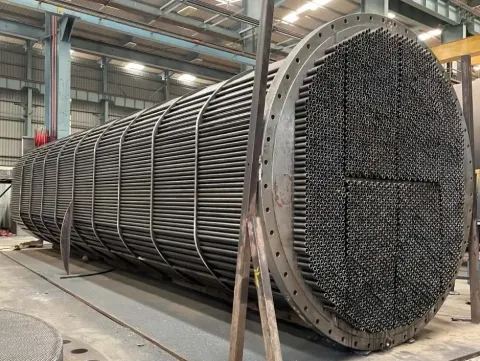
A shell and tube heat exchanger consists of a bundle of tubes enclosed inside a larger cylindrical shell. One fluid flows through the tubes, while another passes through the shell around them. Heat transfers through the tube walls without direct mixing of the two fluids.
These systems are suitable for applications involving elevated temperatures, high pressures, and demanding industrial conditions. Their configurations can be adjusted through different tube arrangements, baffle designs, and flow-pass combinations.
Plate heat exchanger
A plate heat exchanger contains multiple thin metal plates arranged to create alternating channels for hot and cold fluids. The large surface area supports efficient heat transfer in a relatively compact structure.
Common designs include gasketed, brazed, welded, and semi-welded plate heat exchangers. They are widely used in food processing, chemical production, HVAC systems, and industrial heating applications.
Air cooled heat exchanger
An air cooled heat exchanger transfers heat from a process fluid to surrounding air. Finned tubes increase the heat-transfer surface, while fans may be used to move air across the equipment.
These systems are useful in locations where cooling water is limited or where water-based cooling infrastructure is difficult to maintain. Their performance depends on ambient temperature, airflow, surface condition, and fan operation.
Water cooled heat exchanger
A water cooled heat exchanger uses water to absorb heat from another fluid. Cooling water may circulate through tubes or plate channels, depending on the equipment design.
These systems are common in power stations, manufacturing facilities, compressors, and industrial refrigeration. Water quality management is important because mineral deposits, corrosion, and biological growth can reduce heat-transfer performance.
Main Components and Features
The construction of an industrial heat exchanger depends on its design, but several components are commonly used to support heat transfer, pressure containment, and operational control.
Heat-transfer surface: The tubes, plates, or separating material through which thermal energy passes.
Shell or outer frame: Provides structural support and contains the fluid passages.
Tubes and tube sheets: Hold and separate tube-side flow paths in shell and tube designs.
Plates and gaskets: Create alternating fluid channels in many plate heat exchangers.
Baffles: Direct shell-side flow and support tubes in shell and tube equipment.
Inlet and outlet connections: Allow fluids to enter and leave the equipment.
Supports and foundations: Hold the exchanger securely in its operating position.
Sensors and instruments: Monitor temperature, pressure, and flow conditions.
Insulation: Reduces unwanted heat loss or heat gain where required.
Working Principle of an Industrial Heat Exchanger
Industrial heat exchangers operate through the transfer of thermal energy from a hotter fluid to a colder fluid. The fluids generally move through separate passages, allowing heat transfer without direct contact.
The basic operating process involves several stages:
Fluid entry: Hot and cold fluids enter their designated channels through separate connections.
Flow distribution: Internal passages, tubes, or plates distribute the fluids across the heat-transfer surface.
Thermal transfer: Heat moves from the hotter fluid through the separating material to the colder fluid.
Temperature change: The hot fluid loses heat while the colder fluid gains heat.
Fluid discharge: Both streams leave through their respective outlets at different temperatures.
Performance monitoring: Instruments measure operating conditions to help maintain the required process range.
Three common flow arrangements are used:
Parallel flow: Both fluids move in the same direction.
Counterflow: The fluids move in opposite directions. This arrangement can maintain a stronger average temperature difference across the equipment.
Crossflow: The fluids move across one another, often at approximately right angles.
Heat-transfer performance depends on surface area, material properties, fluid velocity, temperature difference, and resistance caused by deposits or fouling.
Materials Used in Heat Exchanger Construction
Material selection influences heat-transfer performance, corrosion resistance, mechanical strength, and equipment life. The correct material depends on the fluids, operating temperature, pressure, and surrounding environment.
Material | Typical characteristics | Common applications |
|---|---|---|
Stainless steel | Corrosion resistance and mechanical strength | Food processing, chemical plants, water systems |
Carbon steel | Strength and broad industrial use | General process heating and cooling |
Copper alloys | Good thermal conductivity | Condensers and selected cooling systems |
Titanium | Resistance to many corrosive environments | Seawater and chemical processing |
Nickel alloys | Suitable for certain high-temperature environments | Specialised chemical processing |
Aluminium | Low weight and good thermal conductivity | Air cooled equipment and compact systems |
A stainless steel heat exchanger is frequently used where corrosion resistance, cleanability, and controlled fluid contact are important. However, stainless steel grades differ in their resistance to specific chemicals and chloride environments. Material selection should be based on the actual fluid composition and operating conditions.
Industrial Applications
Industrial heat exchangers are used in many sectors because heating and cooling are essential parts of numerous production processes.
Industry | Typical application |
|---|---|
Oil and gas | Crude oil heating, gas cooling, condensation |
Chemical processing | Reactor temperature control and fluid cooling |
Power generation | Steam condensation and feedwater heating |
Food and beverage | Liquid heating, cooling, and pasteurisation |
Pharmaceutical manufacturing | Temperature-controlled process operations |
Steel manufacturing | Furnace cooling and process heat recovery |
Automotive manufacturing | Engine, oil, and equipment cooling |
HVAC systems | Chilled water, hot water, and building climate control |
Pulp and paper | Liquor heating and process-water temperature regulation |
Marine operations | Engine cooling and auxiliary heat transfer |
A process heat exchanger is generally selected as part of a wider production system. Engineers consider process flow diagrams, fluid properties, required inlet and outlet temperatures, pressure limits, and expected operating conditions before finalising the design.
Technologies Used in Modern Heat Exchangers
Modern heat exchanger development focuses on improved thermal performance, better monitoring, compact construction, and reduced energy consumption.
Computational fluid dynamics (CFD): Helps engineers study fluid movement, pressure drop, temperature distribution, and possible flow restrictions.
Compact plate designs: Increase heat-transfer area within a relatively small equipment footprint.
Advanced surface geometries: Corrugated plates, enhanced tubes, and fin structures improve heat transfer under suitable conditions.
Automated monitoring: Sensors track temperature, pressure, and flow to identify unusual operating conditions.
Digital monitoring systems: Operating data helps maintenance teams identify performance changes and plan inspections.
Waste heat recovery: Captures thermal energy from exhaust gases or hot process streams for reuse.
Variable-speed fans and pumps: Adjust fluid movement to match changing process requirements.
Specialised materials and coatings: Can improve resistance to selected corrosive or fouling environments when properly specified.
Recent Developments and Industry Trends
Industrial heat exchanger development increasingly focuses on energy efficiency, reliability, and compatibility with changing industrial processes.
1. Improved thermal design: Engineers use simulation tools and enhanced surface geometries to improve heat transfer while managing pressure drop.
2. Waste heat recovery: Industrial facilities are assessing opportunities to reuse heat from exhaust gases, hot liquids, and other process streams.
3. Digital condition monitoring: Temperature, pressure, and flow measurements can be analysed to identify fouling, reduced flow, and abnormal operating patterns.
4. Compact equipment layouts: Plate and other compact heat exchanger designs help facilities manage space limitations, particularly where process areas are crowded.
5. Alternative materials: Material research and specialised alloys are relevant to applications involving corrosive fluids, higher temperatures, or demanding operating conditions.
6. Energy integration: Process engineers increasingly examine heating and cooling requirements together, allowing heat from one process stage to support another where technically suitable.
Laws, Policies, and Standards in India
Industrial heat exchangers may fall under different regulatory requirements depending on their design pressure, temperature, fluid, installation, and relationship with boilers or other regulated equipment.
Important Indian standards and regulatory references include:
IS 4503:1967: Indian Standard specification for shell and tube type heat exchangers. BIS records the standard as reviewed in 2023.
IS 10470:1983: Specification for air cooled heat exchangers. BIS records reaffirmation in June 2025.
IS 10123:1982: Data sheet for shell and tube type heat exchangers. BIS records reaffirmation in September 2023.
IS 2825:1969: Code for unfired pressure vessels. Its applicability should be checked against the equipment's design and current regulatory requirements.
The Boilers Act, 2025: Came into force on 1 May 2025. It regulates boilers and relevant boiler components. A heat exchanger is not automatically classified as a boiler simply because it operates at high temperature or pressure.
Occupational Safety, Health and Working Conditions Code, 2020: Provides the wider occupational safety framework for covered establishments. Applicable requirements should be checked for the relevant workplace and state.
Environmental regulations: Facilities may need to comply with pollution-control permissions, effluent requirements, emissions limits, and waste-management rules depending on their industrial activities.
International engineering references may also be specified in industrial projects. These include the ASME Boiler and Pressure Vessel Code, API standards for particular industries, and TEMA standards for tubular heat exchangers.
TEMA published its 2026 standards edition on 1 August 2026, with a six-month transition period for work in progress.
Applicable requirements should be confirmed with the relevant authority, inspection body, and qualified engineering professionals before equipment design, fabrication, installation, or modification.
Best Practices for Selection and Maintenance
Correct equipment selection and regular inspection help maintain safe and stable heat exchanger operation.
Identify process requirements: Record fluid composition, flow rates, inlet and outlet temperatures, and operating pressure.
Select the appropriate design: Compare shell and tube, plate, air cooled, and water cooled configurations against the process conditions.
Check material compatibility: Confirm that tubes, plates, gaskets, and other wetted components are suitable for the fluids.
Assess fouling potential: Consider suspended solids, scale formation, corrosion products, and biological deposits.
Monitor pressure drop: An unexpected increase may indicate blockage, fouling, or changes in flow.
Inspect for leakage: Check joints, gaskets, tube connections, welds, and external surfaces according to the inspection plan.
Maintain cooling systems: Monitor cooling-water quality, airflow, fan condition, and pump performance.
Use suitable cleaning methods: Select mechanical or chemical cleaning methods that do not damage the heat-transfer surface.
Keep maintenance records: Document inspection dates, operating readings, cleaning activities, repairs, and observed changes.
Follow isolation procedures: Before maintenance, isolate the equipment, depressurise it, drain it where required, and confirm safe working conditions.
Tools and Resources
Engineers and plant operators use technical resources to assess heat exchanger performance and plan equipment operation.
Heat exchanger sizing software: Helps estimate heat-transfer area and evaluate preliminary equipment configurations.
CFD software: Supports analysis of fluid flow, temperature distribution, and pressure drop.
Temperature and pressure instruments: Provide operating measurements for monitoring.
Flow meters: Measure fluid movement through the equipment.
Thermal performance calculators: Help estimate heat duty and temperature changes.
BIS standards catalogue: Provides information about relevant Indian Standards and their current status.
ASME and TEMA publications: Provide engineering references for applicable pressure equipment and tubular heat exchanger designs.
Frequently Asked Questions
1. What is an industrial heat exchanger?
An industrial heat exchanger is equipment that transfers heat between fluids at different temperatures. It is used for heating, cooling, condensation, evaporation, and energy recovery.
2. What is the difference between a shell and tube heat exchanger and a plate heat exchanger?
A shell and tube heat exchanger transfers heat through tubes enclosed inside a shell. A plate heat exchanger uses thin metal plates to create alternating flow channels. The appropriate design depends on pressure, temperature, fluid properties, available space, and maintenance requirements.
3. Why is stainless steel used in heat exchangers?
Stainless steel is used because it provides mechanical strength and resistance to corrosion in many environments. The correct grade must be selected according to fluid composition, temperature, and operating conditions.
4. How does an air cooled heat exchanger work?
An air cooled heat exchanger transfers heat from a process fluid to ambient air through finned tubes. Fans may be used to move air across the heat-transfer surface.
5. What factors affect heat exchanger performance?
Performance depends on heat-transfer area, fluid flow rate, temperature difference, material properties, pressure drop, fouling, and equipment condition.
Conclusion
Industrial heat exchangers are important components in manufacturing, power generation, chemical processing, food production, and many other industrial activities. Shell and tube, plate, air cooled, and water cooled designs support different operating conditions and process requirements.
Understanding heat exchanger types, construction materials, working principles, and maintenance practices helps engineers select suitable equipment and maintain reliable operation. Regular monitoring, appropriate cleaning, material compatibility checks, and compliance with applicable Indian standards and safety requirements are important throughout the equipment lifecycle.
Disclaimer: This article is intended for general informational and educational purposes only. It does not replace professional engineering assessment, applicable standards, regulatory guidance, or manufacturer documentation. It does not provide guarantees and is not intended to sell or promote any product, brand, or organisation.

Related Post...
Rebar Cutting Machines: Explore Overview, Basics, Explanation, Knowledge, and Key Details
Updated: November 17, 2026
Read More
Mobile Crushing Plants: Discover Information, Facts, Tips, Resources, and Expert Advice
Updated: November 18, 2026
Read More