Kundan Jewellery Designs: Explore Styles, Trends, Insights, Suggestions, and Useful Resources
Kundan jewellery is a traditional Indian jewellery style recognized for its detailed gemstone setting, gold or gold-alloy framework, and distinctive handcrafted appearance. It is strongly associated with North Indian jewellery traditions and has become an important part of bridal, festive, and ceremonial fashion.
The term kundan jewellery designs can refer to many forms, including necklaces, earrings, bangles, tikas, chokers, bracelets, rings, and coordinated bridal sets.
Traditional Kundan work commonly involves carefully setting gemstones into a prepared framework. Many designs also incorporate techniques such as meenakari, enamel work, pearls, colored gemstones, and uncut stones.
A kundan jewellery design can therefore range from highly traditional pieces inspired by historical motifs to contemporary interpretations designed for lighter and more versatile wear.
Common visual elements include:
Floral and leaf motifs
Peacock patterns
Geometric arrangements
Polki-style uncut stones
Pearls
Emerald-colored stones
Ruby-colored stones
Enamel detailing
Layered necklace structures
Intricate gold-toned frameworks
The appearance of a Kundan piece can vary substantially according to craftsmanship, materials, construction technique, and regional design traditions.
Why Kundan Jewellery Remains Important
Kundan jewellery has cultural significance because it connects contemporary fashion with established Indian craftsmanship.
It is especially visible during weddings and festivals, where jewellery can complement traditional clothing such as lehengas, sarees, shararas, and anarkalis.
The style is also relevant to people interested in heritage jewellery, handcrafted design, regional artistry, and contemporary reinterpretations of traditional forms.
Modern design has expanded the ways Kundan jewellery can be worn. A large bridal necklace may be reserved for ceremonies, while smaller earrings, pendants, or lightweight necklaces can be incorporated into festive or semi-formal wardrobes.
The broader Indian jewellery industry also remains significant. IBEF reported that India's gems and jewellery market stood at approximately ₹7.31 lakh crore in January 2026, with gold jewellery representing a major part of the sector.
Popular Types of Kundan Jewellery
Different jewellery forms provide different styling possibilities.
| Jewellery Type | Common Characteristics | Typical Occasion |
|---|---|---|
| Kundan necklace | Layered or structured gemstone setting | Weddings and festivals |
| Kundan choker | Shorter necklace positioned around the neckline | Bridal and formal wear |
| Kundan earrings | Studs, jhumkas, chandeliers, or drops | Weddings and celebrations |
| Kundan tikka | Forehead ornament | Bridal and ceremonial wear |
| Kundan bangles | Decorative wrist jewellery | Festive and bridal wear |
| Kundan bracelet | More contemporary wrist format | Formal and festive occasions |
| Kundan ring | Statement or traditional finger jewellery | Weddings and celebrations |
| Kundan bridal set | Coordinated necklace, earrings and accessories | Bridal ensembles |
Bridal Kundan Jewellery Sets
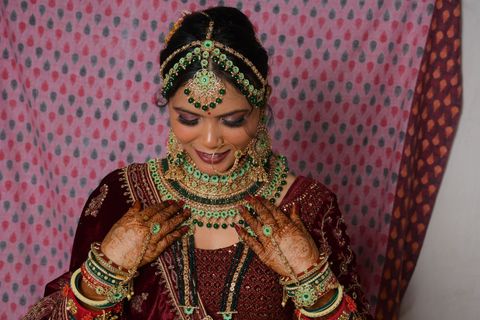
A bridal kundan jewellery set often combines several pieces to create a coordinated appearance.
A traditional bridal combination may contain:
Necklace
Matching earrings
Maang tikka
Nath
Bangles
Bracelet
Ring
Waist ornament
Additional layered necklaces
The choice depends on the bridal outfit, neckline, hairstyle, ceremony, and regional traditions.
A heavily detailed necklace may work well with a relatively simple neckline, while a highly embellished lehenga may pair better with a more controlled jewellery arrangement.
Layering is another important consideration. Instead of wearing every available piece simultaneously, brides can create different combinations for different wedding events.
This makes traditional jewellery more adaptable to modern wedding schedules.
Kundan Necklace Designs
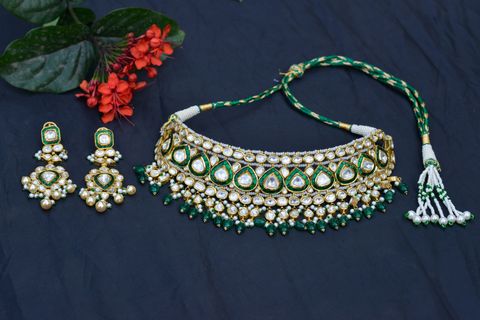
Kundan necklace designs range from compact chokers to long layered necklaces.
Popular design directions include:
Traditional floral necklaces
Multi-layer necklaces
Kundan-polki combinations
Pearl-accented necklaces
Meenakari Kundan necklaces
Choker and long-necklace combinations
Contemporary geometric patterns
Heritage-inspired statement necklaces
Necklace selection should consider the neckline of the outfit.
For example, a choker can emphasize a high or open neckline, while a longer necklace can create a vertical visual effect with traditional clothing.
Kundan Earrings Designs
Kundan earrings designs are available in many shapes and sizes.
Common styles include:
Kundan jhumkas
Chandbali earrings
Drop earrings
Stud earrings
Chandeliers
Floral earrings
Pearl-accented earrings
Long layered earrings
The size of an earring should be considered alongside hairstyle, face framing, outfit embellishment, and necklace design.
When a large Kundan necklace is the primary focal point, smaller earrings can create a more balanced appearance. Alternatively, earrings can become the central element when the necklace is minimal.
Lightweight Kundan Jewellery
Lightweight kundan jewellery has become increasingly relevant as contemporary jewellery design focuses on wearability.
Industry observations presented around IIJS Bharat Signature 2026 indicate stronger interest in lighter, versatile jewellery and designs that retain visual detail while using more efficient construction. GJEPC coverage also noted that bridal jewellery is being reinterpreted through lighter and more modular forms.
Lightweight designs can be useful for:
Longer wedding ceremonies
Daytime functions
Reception events
Festive gatherings
Repeated use
Travel
Contemporary outfits
A lighter design does not necessarily mean a simpler visual appearance. Openwork, smaller stones, modular components, and carefully planned settings can maintain considerable decorative detail.
Antique Kundan Jewellery
Antique kundan jewellery generally refers to designs that draw visual inspiration from historical or heritage jewellery.
Common characteristics include:
Aged or antique-look finishes
Traditional floral motifs
Deeply colored enamel
Pearl details
Heritage-style gemstone arrangements
Elaborate necklace structures
Mughal- or Rajput-inspired visual references
The word "antique" can describe the appearance or design inspiration rather than proving that an item is historically old.
When researching jewellery described as antique, it is therefore useful to distinguish between an authentic historical piece, a reproduction, and a newly crafted design with an antique-style finish.
Recent Kundan and Bridal Jewellery Trends
The 2025–2026 jewellery season has shown a stronger blend of heritage craftsmanship and contemporary usability.
GJEPC industry coverage in 2026 highlighted a movement toward lighter, modular jewellery, while traditional Kundan-Polki floral forms continue to be reinterpreted for modern brides.
Another 2026 industry report from IIJS Bharat Signature described traditional gem-set and plain-gold bridal jewellery as continuing to be important, alongside bolder but lightweight silhouettes for daily and party wear.
At the January 2026 IIJS Bharat Signature exhibition, Kundan craftsmanship was also represented through ornate accessories and decorative pieces, demonstrating that the technique continues to influence designs beyond conventional necklaces and earrings.
Current design directions can therefore be summarized as:
| Trend | Design Direction |
|---|---|
| Heritage revival | Traditional motifs with contemporary construction |
| Lightweight forms | Reduced bulk with detailed surfaces |
| Layering | Multiple shorter and longer pieces |
| Modularity | Pieces that can be worn separately |
| Color | Greater use of colored gemstones and enamel |
| Versatility | Designs suitable for more than one occasion |
| Craftsmanship | Greater emphasis on artisanal detailing |
Choosing Kundan Jewellery for Different Occasions
The same jewellery style does not necessarily suit every occasion.
For a wedding ceremony, larger necklaces and coordinated sets may complement heavily embroidered bridal clothing.
For a reception, contemporary Kundan earrings or a structured necklace can provide a more streamlined appearance.
For festive occasions, smaller necklaces, earrings, bangles, or pendants can provide traditional detailing without creating an overly elaborate combination.
A simple selection framework is:
Wedding ceremony: Traditional layered necklace and matching accessories
Reception: Contemporary necklace or statement earrings
Festival: Medium-sized necklace, earrings, or bangles
Family celebration: Lightweight Kundan pieces
Formal event: Controlled combination of necklace and earrings
Daily festive wear: Smaller earrings or pendant-style pieces
Materials and Craftsmanship to Understand
Kundan jewellery can incorporate several materials, and the appearance alone does not establish the exact composition.
Potential components include:
Gold or gold alloys
Precious or semi-precious stones
Polki or uncut diamonds
Glass or imitation stones
Pearls
Enamel
Meenakari work
Decorative backing materials
When evaluating a jewellery piece, documentation should identify relevant metal purity and other material details where applicable.
For hallmarked gold jewellery in India, BIS states that the hallmark includes the BIS logo, purity/fineness marking, and a six-digit alphanumeric HUID. Consumers can use the BIS Care App's "Verify HUID" feature to check HUID information.
Laws and Hallmarking Rules in India
Gold jewellery in India is subject to the BIS hallmarking framework in districts covered by mandatory hallmarking orders.
BIS currently lists amendments to the mandatory hallmarking order through 3 August 2026, including amendments dated 31 July 2025, 2 March 2026, 28 April 2026, and 3 August 2026.
The March 2026 amendment added seven additional districts to mandatory hallmarking coverage, including Rupnagar in Punjab, Banda in Uttar Pradesh, Beed in Maharashtra, Gomati in Tripura, Katihar in Bihar, Beawar in Rajasthan, and Neemuch in Madhya Pradesh.
An important point for Kundan jewellery is that BIS lists Kundan, Polki, and Jadaau among special categories exempted from mandatory hallmarking under the applicable mandatory-hallmarking framework. This does not mean that every Kundan piece lacks information about its materials or that documentation is unnecessary.
Where gold jewellery is hallmarked, BIS guidance states that bills or invoices should include the description of each article, net weight of precious metal, purity in carat and fineness, and hallmarking charges.
Consumers can also have jewellery tested at BIS-recognized Assaying and Hallmarking Centres, subject to the applicable process and charges.
Tools and Useful Resources
Several resources can help when researching Kundan jewellery.
BIS Hallmarking Information: Useful for understanding gold purity, hallmark components, HUID, and applicable hallmarking rules.
BIS Care App: The official BIS application includes a "Verify HUID" feature for eligible hallmarked gold jewellery.
BIS Hallmarking Portal: Useful for information concerning registered jewellers, hallmarking centres, and regulatory procedures.
GJEPC industry publications: Useful for following contemporary Indian jewellery design directions, exhibitions, craftsmanship, and market developments. The 2026 IIJS coverage provides examples of current design trends.
Jewellery comparison checklist: Record metal purity, stone type, dimensions, weight, hallmark information, craftsmanship, care requirements, and documentation.
Practical Kundan Jewellery Care
Traditional and gemstone-set jewellery should generally be handled carefully.
Useful practices include:
Keep jewellery away from harsh chemicals.
Remove pieces before activities involving water or chemicals.
Store necklaces separately to reduce tangling.
Use soft-lined storage compartments.
Avoid dropping pieces onto hard surfaces.
Keep earrings and necklace components together.
Clean according to the materials and manufacturer's guidance.
Inspect stone settings periodically.
Keep documentation with the jewellery.
Avoid applying perfume directly onto jewellery.
For antique-style or highly intricate Kundan pieces, professional inspection may be appropriate when settings become loose or damaged.
Frequently Asked Questions
What are Kundan jewellery designs?
Kundan jewellery designs are traditional Indian jewellery styles characterized by detailed gemstone setting and decorative frameworks. They can include necklaces, earrings, bangles, rings, tikas, and coordinated bridal sets.
What is included in a bridal Kundan jewellery set?
A bridal set can include a necklace, matching earrings, maang tikka, bangles, rings, nath, and other accessories. The exact combination varies according to regional customs and personal styling.
Are lightweight Kundan jewellery designs suitable for weddings?
Yes. Lightweight designs can be used for weddings, especially for ceremonies where jewellery needs to remain comfortable for extended periods. Contemporary designs can retain traditional motifs while using lighter construction.
What is the difference between antique Kundan jewellery and traditional Kundan jewellery?
Antique Kundan jewellery generally refers to a heritage-inspired appearance or an older piece, whereas traditional Kundan jewellery describes a broader design and craftsmanship tradition. A newly made piece can have an antique-style finish without being historically old.
Can Kundan jewellery have a BIS hallmark?
Some Kundan jewellery can be hallmarked when it falls within the applicable hallmarking framework, but BIS specifically lists Kundan, Polki, and Jadaau among special categories exempted from mandatory hallmarking. The applicable rules should be checked for the particular article and location.
Conclusion
Kundan jewellery continues to connect India's traditional craftsmanship with changing contemporary jewellery preferences. From elaborate bridal necklaces to compact earrings and lightweight festive pieces, the design category encompasses a wide range of styles.
Recent 2026 industry coverage points toward a combination of heritage and modernity, with lighter construction, modular designs, layering, colorful gemstones, and versatile jewellery gaining attention while traditional bridal craftsmanship remains important.
For anyone researching kundan jewellery designs, kundan necklace designs, kundan earrings designs, lightweight kundan jewellery, or antique kundan jewellery, it is useful to consider craftsmanship, materials, design proportions, occasion, comfort, documentation, and applicable hallmarking rules together.
Kundan jewellery is ultimately more than a decorative style. Its continuing relevance comes from the combination of Indian artistic traditions, gemstone craftsmanship, cultural symbolism, and the ability of designers to reinterpret heritage forms for contemporary use.
Disclaimer
This article is provided for general informational and educational purposes only. It does not constitute financial, legal, jewellery-appraisal, or professional advice. The information presented is not intended to make or imply any guarantee, certification, valuation, authenticity determination, or specific claim about any jewellery, designer, manufacturer, retailer, or product. Rules and regulations may change, so readers should consult the relevant official authorities for the latest requirements. The main purpose of this article is to provide information and general knowledge only. We are not selling, promoting, endorsing, or recommending any of the jewellery, products, brands, or entities discussed in this article.

Related Post...
Kundan Jewellery Designs: Explore Styles, Trends, Insights, Suggestions, and Useful Resources
Updated: November 02, 2026
Read More
Solitaire Engagement Rings: Explore Styles, Insights, Suggestions, Help, and Useful Resources
Updated: October 26, 2026
Read More
Tiny Solitaire Pendants: Explore Styles, Insights, Suggestions, Help, and Useful Resources
Updated: October 26, 2026
Read More