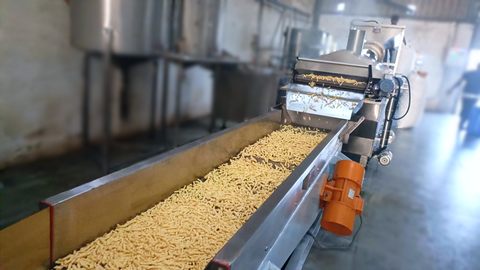
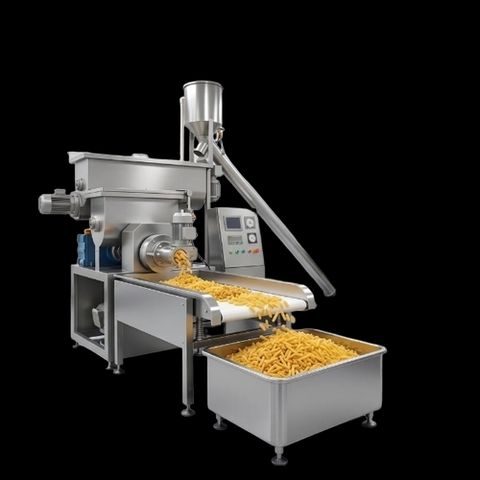
Pasta Making Machines: Explore Types, Features, Applications, and Useful Resources
Pasta is a popular food product prepared mainly from wheat flour or semolina mixed with water. It is manufactured in various shapes and sizes, including spaghetti, macaroni, penne, fusilli, shells, and fettuccine. As demand for packaged pasta continues to develop, food manufacturers use specialised machinery to prepare dough, form different shapes, dry products, and package finished items.
A pasta making machine is equipment designed to convert prepared ingredients into pasta through different operations, including mixing, kneading, extrusion, shaping, and cutting. Depending on production requirements, machinery can range from compact tabletop units to large automated manufacturing lines.
A small scale pasta making machine is generally suitable for limited-volume production, fresh pasta preparation, and product development. An industrial pasta making machine is designed for larger manufacturing operations that require consistent output and coordinated processing stages.
Importance of Pasta Making Machines
Pasta manufacturing involves several stages that require consistent ingredient preparation, dough texture, product dimensions, and processing conditions. Machinery helps coordinate these activities and maintain uniform production.
Important benefits include:
Consistent product shape: Forming and cutting systems help maintain standard dimensions.
Improved production efficiency: Automated operations reduce repetitive manual activities.
Better process control: Adjustable settings help manage mixing, extrusion, cutting, and drying.
Product variety: Different dies and shaping attachments support multiple pasta varieties.
Production planning: Machine capacity helps manufacturers organise batches and output.
Packaging preparation: Integrated handling systems prepare products for weighing and packaging.
The appropriate equipment depends on the type of pasta, required production volume, ingredient formulation, available floor space, and desired level of automation.
Types of Pasta Making Machines
Different machines are used for individual processing stages or as part of a complete manufacturing line.
1. Small Scale Pasta Making Machine
A small scale pasta making machine is designed for limited production volumes. It is commonly used in small food-processing units, restaurants, commercial kitchens, and product-development facilities.
Key features include:
Compact construction and relatively simple operation.
Manual or semi-automatic controls.
Interchangeable shaping attachments.
Batch-based dough preparation.
Suitability for fresh pasta production.
These machines are useful for preparing limited quantities and testing different pasta shapes and formulations.
2. Automatic Pasta Making Machine
An automatic pasta making machine combines several operations through mechanical controls, sensors, and automated feeding systems.
Its features may include:
Automatic ingredient feeding.
Controlled dough mixing and kneading.
Continuous or programmed extrusion.
Adjustable cutting systems.
Production monitoring and safety controls.
These machines are useful in manufacturing environments where consistent output and reduced manual intervention are important.
3. Industrial Pasta Making Machine
An industrial pasta making machine is designed for larger manufacturing facilities. It may operate as an individual production unit or as part of a connected processing line.
Common characteristics include:
Heavy-duty construction.
High-capacity mixing and extrusion systems.
Continuous product handling.
Automated temperature and moisture controls.
Integration with drying, cooling, and packaging equipment.
Industrial configurations can be designed for different pasta varieties and production requirements.
4. Pasta Extrusion Machine
A pasta extrusion machine pushes prepared dough through a shaped die to create specific pasta forms. The die determines the product's cross-section and shape.
Examples include:
Spaghetti and linguine.
Penne and macaroni.
Fusilli and other spiral shapes.
Shell-shaped pasta.
Speciality and customised pasta shapes.
Extrusion machines can be configured with different dies according to the required product dimensions and formulation.
5. Pasta Sheeting and Cutting Machine
This equipment rolls dough into sheets of a selected thickness and cuts it into specific shapes. It is commonly used for flat pasta products.
Typical applications include:
Lasagna sheets.
Fettuccine.
Tagliatelle.
Ravioli sheets.
Other flat pasta varieties.
Adjustable rollers and cutting attachments help control sheet thickness and product width.
6. Pasta Drying Machine
A pasta drying machine reduces moisture in pasta to improve storage stability and prepare the product for packaging.
Important features include:
Temperature regulation.
Humidity monitoring.
Controlled airflow.
Adjustable drying schedules.
Conveyor or cabinet-based arrangements.
Drying conditions vary according to pasta shape, thickness, formulation, and production method.
7. Pasta Packaging Machine
Packaging equipment weighs, fills, and seals finished pasta products. It may be connected to automatic weighing systems and product conveyors.
Common functions include:
Automatic product weighing.
Bag or pouch filling.
Heat sealing.
Batch coding and date marking.
Finished-package handling.
Main Components and Features
A pasta processing line contains different components that perform specific operations. Their arrangement depends on the product and manufacturing process.
| Component | Main function |
|---|---|
| Ingredient feeder | Supplies flour, semolina, and other ingredients |
| Mixer | Combines the ingredients |
| Dough kneader | Develops a uniform dough texture |
| Extruder | Forces dough through shaping dies |
| Die assembly | Determines pasta shape and dimensions |
| Cutter | Cuts pasta to the required length |
| Conveyor | Transfers products between processing stages |
| Dryer | Reduces moisture content |
| Cooling unit | Helps stabilise dried pasta |
| Packaging unit | Weighs, fills, and seals finished products |
Important machine features include adjustable speed, temperature controls, food-contact surfaces, easy-cleaning arrangements, overload protection, and operator safety systems.
Pasta Manufacturing Process
A pasta manufacturing machine operates through a sequence of processing stages. The exact arrangement depends on whether the product is fresh, dried, filled, or speciality pasta.
Typical production flow:
Ingredient preparation: Semolina or flour is checked and measured. Water and other permitted ingredients are prepared according to the formulation.
Mixing: Ingredients are combined to create a consistent mixture.
Kneading: The mixture is worked into a suitable dough.
Shaping: Dough is extruded through dies or passed through rollers.
Cutting: Shaped pasta is cut to the required length or dimensions.
Drying: Products intended for longer storage undergo controlled moisture reduction.
Cooling: Dried pasta is cooled before further handling.
Inspection: Products are checked for shape, dimensions, appearance, and other quality requirements.
Packaging: Finished pasta is weighed and packed in suitable packaging material.
Applications of Pasta Processing Equipment
Pasta processing equipment is used in different food-production environments.
Commercial food manufacturing: Large production lines manufacture packaged pasta in standard shapes.
Small food-processing units: Compact machines support limited-volume pasta production.
Restaurant kitchens: Fresh pasta machines prepare pasta for immediate cooking.
Speciality food production: Shaping attachments support customised pasta varieties.
Institutional kitchens: Selected equipment helps prepare pasta in larger quantities.
Product-development facilities: Small machines are used to test dough formulations and product shapes.
Technologies Used in Modern Pasta Manufacturing
Modern machinery uses mechanical and digital technologies to improve process control and production consistency.
Programmable Logic Controllers (PLCs): PLCs coordinate machine operations, timing, and selected process settings.
Variable Frequency Drives (VFDs): VFDs regulate motor speed in mixers, conveyors, and other equipment.
Temperature and humidity sensors: These sensors monitor drying conditions and help maintain suitable processing environments.
Automatic feeding systems: Automated feeders control the supply of ingredients to mixing and processing units.
Digital monitoring: Operators can monitor selected production parameters through control panels and industrial monitoring systems.
Food-grade construction: Stainless steel and suitable food-contact materials are commonly used in equipment that handles ingredients and finished products.
Recent Developments and Industry Trends
Pasta manufacturing is increasingly adopting automation, digital monitoring, and energy-conscious processing methods. These developments help manufacturers manage production consistency and reduce avoidable process variations.
Some notable trends include:
Greater automation: Integrated lines connect mixing, extrusion, drying, and packaging operations.
Digital process monitoring: Sensors and control panels track temperature, humidity, motor speed, and production settings.
Flexible shaping systems: Interchangeable dies and cutting attachments support different pasta shapes.
Improved drying control: Modern drying systems use controlled airflow and humidity settings to manage product moisture.
Compact production systems: Smaller machinery configurations support limited-volume manufacturing and product development.
Resource management: Equipment design increasingly considers efficient use of electricity, water, and raw materials.
Food manufacturers in India should also monitor changes to FSSAI regulations, including licensing, packaging, labelling, and hygiene requirements. Regulatory updates can affect manufacturing procedures and packaged-product information.
Laws, Policies, and Standards in India
Pasta manufacturing units in India must follow applicable food safety, hygiene, packaging, labelling, and business registration requirements.
1. Food Safety and Standards Act, 2006
The Food Safety and Standards Act, 2006 provides the main legal framework for food safety in India. Food manufacturers must comply with applicable regulations and requirements issued under this Act.
2. FSSAI Licensing and Registration
Food manufacturing units generally need the appropriate FSSAI registration or licence, depending on their activities and applicable eligibility criteria.
The Food Safety and Standards (Licensing and Registration of Food Businesses) Regulations, 2011, as amended, govern these requirements. Manufacturers should check the latest eligibility conditions and licensing procedures before starting operations.
3. Food Product Standards
Pasta products such as macaroni, spaghetti, and vermicelli are covered under the Food Safety and Standards (Food Products Standards and Food Additives) Regulations, 2011.
Manufacturers should review applicable product definitions, ingredient requirements, and quality parameters to ensure that their products meet the relevant standards.
4. Hygiene and Food Safety Management
Food manufacturers must maintain suitable hygienic conditions throughout production. FSSAI Schedule 4 includes requirements for manufacturing, processing, packaging, and storage operations.
Important practices include:
Maintaining clean production areas and equipment.
Preventing contamination during ingredient handling.
Providing suitable handwashing and sanitation facilities.
Monitoring pest-control arrangements.
Maintaining documented food safety procedures.
Applying Good Manufacturing Practices (GMP) and Good Hygiene Practices (GHP).
Food Safety Management Systems based on Hazard Analysis and Critical Control Point (HACCP) principles can help identify and control food safety risks.
5. Packaging and Labelling
Packaged pasta must comply with applicable FSSAI packaging and labelling requirements.
Labels may need to include:
Product name.
Ingredient information.
Allergen declarations, where applicable.
Nutritional information.
Net quantity.
Batch identification.
Manufacturer details.
Other prescribed declarations.
Manufacturers should consult the latest Packaging Regulations, 2018, and Labelling and Display Regulations, 2020, including subsequent amendments.
Best Practices for Operating Pasta Making Machinery
Correct machine operation supports product consistency, equipment reliability, and hygienic production.
Check ingredients: Use suitable flour or semolina and verify ingredient quality before processing.
Maintain dough consistency: Follow controlled ingredient ratios and mixing procedures.
Select suitable dies: Match the die design to the required pasta shape and dimensions.
Monitor extrusion: Check dough flow, machine speed, and product formation.
Control drying conditions: Adjust temperature, humidity, and airflow according to product requirements.
Clean equipment regularly: Remove dough residues from mixers, dies, rollers, and conveyors.
Inspect moving parts: Check belts, motors, bearings, cutters, and safety guards.
Train operators: Ensure workers understand operating procedures and emergency controls.
Maintain production records: Record ingredient batches, process parameters, cleaning activities, and inspection results.
Follow food safety procedures: Prevent cross-contamination and maintain suitable storage conditions.
Useful Tools and Resources
Manufacturers can use different technical resources to plan, operate, and maintain pasta production systems.
| Tool or resource | Purpose |
|---|---|
| Production capacity calculator | Estimates output based on operating hours and machine capacity |
| Ingredient formulation sheet | Records flour, semolina, water, and other ingredient proportions |
| Moisture meter | Measures moisture levels in pasta |
| Temperature and humidity sensors | Monitor drying conditions |
| Digital weighing system | Checks ingredient and finished-product quantities |
| Preventive maintenance checklist | Organises routine machine inspections |
| Food safety management plan | Documents hygiene and process-control procedures |
| FSSAI regulations and guidance | Provides information on Indian food safety requirements |
Before selecting a pasta processing equipment setup, manufacturers should review the following technical factors:
Required output per hour or production shift.
Types and shapes of pasta to be manufactured.
Fresh or dried pasta production requirements.
Available electricity and water supply.
Floor space and factory layout.
Cleaning and maintenance arrangements.
Compatibility between individual machines.
Packaging format and finished-product storage needs.
Frequently Asked Questions
1. What is a pasta making machine?
A pasta making machine is equipment used to mix, knead, shape, extrude, or cut dough into pasta products. Depending on its configuration, it may also be integrated with drying and packaging units.
2. What is the difference between an automatic and an industrial pasta making machine?
An automatic pasta making machine uses automated controls to perform selected production operations. An industrial pasta making machine is generally designed for larger production volumes and may include several connected processing stages.
3. Which pasta shapes can be produced using pasta processing equipment?
Depending on the machine and shaping attachments, equipment can produce spaghetti, macaroni, penne, fusilli, vermicelli, fettuccine, lasagna sheets, and other pasta varieties.
4. What is the function of a pasta extrusion machine?
A pasta extrusion machine pushes prepared dough through a shaped die. The die determines the pasta's cross-section, while cutting equipment controls its length.
5. What factors should be considered when selecting a high capacity pasta production machine?
Important factors include hourly output, pasta variety, automation level, drying requirements, energy consumption, floor space, cleaning arrangements, and compatibility with other production equipment.
Conclusion
Pasta making machines play an important role in modern pasta manufacturing by supporting ingredient mixing, dough preparation, shaping, cutting, drying, and packaging. Different equipment configurations are available for small-scale production, commercial kitchens, and large industrial facilities.
An automatic pasta making machine can coordinate multiple operations, while an industrial pasta making machine can support higher production volumes and integrated processing. Understanding machine types, components, operating principles, food safety requirements, and maintenance practices helps manufacturers plan suitable production systems.
As automation and digital monitoring continue to develop, pasta processing equipment is becoming more adaptable to different product shapes and manufacturing requirements. Proper equipment selection and controlled operating practices remain important for consistent production.
Disclaimer: This article is intended for general informational and educational purposes only. Machinery specifications, operating procedures, and regulatory requirements may vary. Consult qualified technical professionals and the latest official regulations before making manufacturing or compliance decisions. This content does not guarantee any particular production result and is not intended to promote any product, brand, or organisation.

Related Post...
Paper Straw Making Machines: Explore Overview, Basics, Explanation, Knowledge, and Key Details
Updated: November 13, 2026
Read More
Industrial Bread Making Machines: Explore Overview, Basics, Explanation, Knowledge, and Key Details
Updated: November 13, 2026
Read More
Rail Welding Machines: Discover Information, Facts, Tips, Resources, and Expert Advice
Updated: November 13, 2026
Read More