Hyundai Stargazer: Explore Features, Specifications, Technologies, and Useful Resources
The Hyundai Stargazer is a multi-purpose vehicle (MPV) developed for families and passengers who need a spacious cabin, flexible seating and practical everyday transportation. Its design combines the elevated body style of a family vehicle with modern exterior details, digital technology and a cabin arranged to accommodate up to seven occupants in selected versions.
The Hyundai Stargazer is primarily associated with markets in Southeast Asia, including Indonesia. Specifications, equipment and available variants can differ by country and model year. It is therefore important to distinguish between the features of a particular market version and equipment that may not be available in another region.
The vehicle is known for its distinctive front design, wide dashboard layout, flexible seating arrangement and petrol engine. This guide explains the Hyundai Stargazer MPV, its specifications, interior features, exterior design, engine, technology, safety systems and useful resources.
Importance of the Hyundai Stargazer MPV
An MPV is designed to balance passenger accommodation, luggage capacity and daily driving practicality. The Hyundai Stargazer follows this approach through its three-row seating layout and family-oriented cabin.
Its main areas of practical importance include:
Passenger capacity: Selected versions provide seating for up to seven people.
Flexible cabin: Three rows support different passenger and luggage arrangements.
Everyday usability: A relatively compact MPV body makes it suitable for urban and suburban travel.
Modern equipment: Depending on the variant, the vehicle includes touchscreen infotainment, smartphone connectivity and digital displays.
Family-oriented design: Storage spaces, cabin access and seating arrangements support regular family journeys.
The Stargazer may be considered by people comparing compact and mid-size family MPVs. However, the final choice depends on local availability, passenger requirements, road conditions and the equipment included in the specific variant.
Hyundai Stargazer specifications
The following figures are based mainly on Hyundai Indonesia's published specifications. They describe a representative petrol-powered Stargazer configuration and should not be treated as confirmed specifications for every market or model year.
Specification | Published details |
|---|---|
Vehicle type | Multi-purpose vehicle (MPV) |
Seating capacity | 6 or 7, depending on configuration |
Engine | Smartstream G1.5 MPI, four-cylinder petrol |
Engine displacement | 1,497 cc |
Maximum power | 115 PS at 6,300 rpm |
Maximum torque | 143.8 Nm at 4,500 rpm |
Transmission | 6-speed manual or IVT, depending on variant |
Front suspension | MacPherson strut |
Rear suspension | Coupled torsion beam axle |
Length | Approximately 4,460 mm |
Width | Approximately 1,780 mm |
Height | Approximately 1,695 mm |
Wheelbase | Approximately 2,780 mm |
The dimensions and equipment can differ on the Stargazer X and newer market-specific versions. For example, the Stargazer X has a different exterior body treatment and larger overall dimensions in its published Indonesian specification sheet.
Hyundai Stargazer exterior design
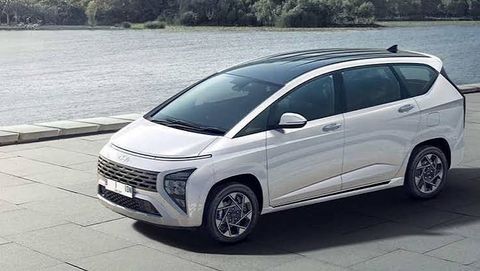
The Hyundai Stargazer exterior design uses a modern MPV shape with a relatively tall roof, a long wheelbase and a rounded body profile. Its styling is intended to balance passenger space with a distinctive appearance.
Common exterior design elements include:
Front lighting: A wide front lighting arrangement gives the vehicle a recognisable appearance.
Front grille: The grille and bumper design vary according to the trim and market.
Side profile: Large windows and a long roofline support visibility and cabin space.
Rear design: The rear lighting arrangement and tailgate styling create a distinctive look.
Wheel options: Alloy wheel designs and sizes depend on the selected version.
Roof and body details: Certain versions include additional exterior trim and roof-related design elements.
The Stargazer X is a more rugged-looking version, with crossover-inspired exterior styling, protective-looking body cladding and a slightly revised stance. It should be understood as a distinct variant rather than assuming that every Stargazer has the same exterior equipment.
Hyundai Stargazer interior features
The Hyundai Stargazer interior is arranged around three rows of seats. Depending on the market and variant, buyers may find either a six-seat configuration with second-row captain seats or a seven-seat layout with a second-row bench.
Important interior features include:
Three-row seating: The cabin is designed to accommodate families and groups.
Captain seats: Selected six-seat versions have separate second-row seats, creating a passage to the third row.
Digital instrument display: A digital or LCD instrument cluster presents driving information.
Infotainment screen: Published Indonesian versions include an 8-inch display audio system with smartphone connectivity.
Wireless charging: Selected variants include a wireless smartphone charging tray.
Rear air conditioning: Rear ventilation helps distribute cooled air to passengers in the back rows.
Cabin storage: Hyundai highlights more than 30 storage areas in the cabin, although the exact arrangement depends on the version.
Flexible luggage area: Folding or adjusting the rear seating arrangement can create additional space for luggage.
Hyundai's published interior information confirms the six- and seven-seat options, captain-seat layout, 8-inch display audio and wireless charging on specified versions.
Seating and luggage practicality
A three-row vehicle requires a balance between passenger capacity and luggage room. The Stargazer's published brochure lists approximately 200 litres of luggage capacity behind the third row and 585 litres behind the second row under its stated measurement method. Actual usable space depends on the seat position and measurement standard.
Before selecting a configuration, passengers should check third-row access, headroom, legroom and the amount of luggage space remaining when all seats are occupied.
Hyundai Stargazer engine and performance
The Hyundai Stargazer is offered in several markets with a 1.5-litre Smartstream petrol engine. The published Indonesian specification identifies it as a four-cylinder, multi-point-injection engine with a displacement of 1,497 cc.
Its listed output is 115 PS and 143.8 Nm of torque. Depending on the variant, the engine is paired with either a six-speed manual transmission or an Intelligent Variable Transmission (IVT).
The IVT is designed to vary the engine-to-wheel ratio smoothly rather than using a conventional set of fixed gear steps. This can support smooth acceleration in everyday driving. The manual transmission provides direct driver control over gear selection.
Driving modes
Hyundai's Indonesian product information describes four driving modes:
Normal: Intended for regular everyday driving.
Eco: Adjusts vehicle response with fuel efficiency in mind.
Sport: Provides a more responsive driving character.
Smart: Adjusts transmission behaviour based on driving patterns.
The availability of these modes depends on the vehicle version.
Hyundai Stargazer technology and connectivity
Technology in the Stargazer focuses on infotainment, driver information, connected-car functions and convenience. The exact equipment depends on the market and trim level.
Infotainment and digital displays
Selected versions include an 8-inch touchscreen display audio system. It supports smartphone connectivity and can provide access to compatible entertainment and navigation functions through connected devices.
Other available features may include:
Digital instrument cluster
Bluetooth hands-free connectivity
Steering-wheel audio controls
USB charging and multimedia ports
Wireless smartphone charging
Voice recognition on selected systems
Bluelink connected-car technology
Hyundai Bluelink can provide vehicle information and selected remote or emergency assistance functions where the system is supported. Features may require an active subscription, compatible mobile network and regional service availability.
Hyundai SmartSense driver assistance
Selected Stargazer variants are equipped with Hyundai SmartSense driver-assistance technologies. Depending on the version, these can include:
Technology | Main function |
|---|---|
Forward Collision-Avoidance Assist (FCA) | Warns of certain forward collision risks and may assist with braking |
Lane Keeping Assist (LKA) | Helps warn or correct unintended lane departure |
Lane Following Assist (LFA) | Helps the vehicle remain centred in a detected lane |
Blind-Spot Collision-Avoidance Assist (BCA) | Monitors selected blind-spot areas |
Rear Cross-Traffic Collision-Avoidance Assist (RCCA) | Helps detect approaching traffic while reversing |
High Beam Assist (HBA) | Adjusts headlamp beam settings in response to detected traffic |
Driver Attention Warning (DAW) | Alerts the driver to signs of reduced attention |
Rear View Monitor (RVM) | Displays the rear camera view when reversing |
These systems are driver-assistance technologies, not substitutes for careful driving. Their operation can be affected by weather, road markings, visibility and sensor conditions. Hyundai also states that some SmartSense functions are restricted to specified trims.
Hyundai Stargazer safety features
Safety equipment varies by market and trim. Published Indonesian brochures list features such as anti-lock braking, electronic stability control, hill-start assistance, child-seat anchorage points and airbags. Higher versions may include additional driver-assistance functions and a six-airbag arrangement.
Important safety features to check include:
Airbags: Confirm the number and locations of airbags in the specific vehicle.
ABS: Helps prevent wheel lock during hard braking.
Electronic Stability Control: Helps maintain vehicle stability in certain situations.
Hill-Start Assist: Helps reduce rollback when moving off on an incline.
ISOFIX anchorage points: Support the installation of compatible child seats.
Rear camera and parking warnings: Assist with reversing and parking.
Seatbelt reminders: Encourage occupants to use seatbelts.
The ASEAN NCAP assessment information for the Stargazer provides additional regional safety data, but equipment and assessment applicability should be checked against the exact model year and market.
Hyundai Stargazer variants and available versions
The Stargazer range includes different trims and market-specific versions. In Indonesia, published product information has included versions such as Active, Essential, Style and Prime. The Stargazer X adds crossover-inspired styling and its own equipment differences.
More recent Indonesian product information also lists the Stargazer Cartenz and Cartenz X. These names represent updated market-specific versions, so their features should not automatically be attributed to earlier Stargazer models.
When comparing variants, consider:
Seating configuration: six or seven seats
Manual or IVT transmission
Infotainment screen and connected features
Airbag count and stability systems
Availability of SmartSense functions
Wheel design and exterior trim
Rear air conditioning and convenience equipment
Hyundai Stargazer availability in India
The Hyundai Stargazer is primarily marketed in Southeast Asian countries. As of November 2026, it is not listed as a regular model in Hyundai India's passenger-vehicle range, and Indian-market availability should not be assumed. An Indian launch, local specification sheet or official price announcement would be needed before treating it as an available domestic model.
For readers in India, this distinction is important because a vehicle sold in Indonesia may have different safety equipment, engine calibration, infotainment functions and regulatory approvals from a vehicle intended for India.
If a Stargazer is considered through an import route, the applicable Indian import, registration, homologation and road-use requirements need to be checked with the relevant authorities before any decision.
Recent developments and market trends
The Stargazer range has evolved through market-specific updates rather than remaining identical across all countries.
Updated equipment: Hyundai's Indonesian materials describe versions with connected-car features, digital displays and additional driver-assistance functions.
Stargazer X: This version adds crossover-inspired exterior details and a different equipment combination.
Cartenz range: Hyundai Indonesia's current product information includes Stargazer Cartenz and Cartenz X, showing how the model family has expanded in that market.
Greater driver assistance: Features such as lane assistance, forward collision warnings and blind-spot monitoring reflect the wider adoption of driver-assistance technology in family vehicles.
Hyundai Indonesia+2
Buyers should use the latest brochure for their country because equipment, dimensions and specifications can change between model years.
Laws, regulations and vehicle standards in India
Although the Hyundai Stargazer is not currently a regular Indian-market model, Indian vehicle regulations are relevant when assessing any imported or future India-spec version.
Motor Vehicles Act, 1988: This is the principal legislation governing motor vehicles in India. It provides the legal framework for vehicle registration, licensing and road-use requirements.
Central Motor Vehicles Rules, 1989: These rules cover important vehicle requirements, including safety-related equipment, registration procedures and applicable technical provisions.
Type approval and homologation: Vehicles introduced into the Indian market must meet applicable Indian technical and regulatory requirements. An overseas specification sheet does not establish compliance for India.
Bharat NCAP: This Indian vehicle safety assessment programme provides crash-test information for vehicles within its assessment scope. A safety rating should only be attributed to a model when an applicable test result is published.
Emission requirements: Any India-market version would need to meet the emission standards applicable at the time of its approval and registration.
Regulatory requirements can change. Anyone assessing an imported or future India-spec Stargazer should verify current requirements with the Ministry of Road Transport and Highways, the relevant testing agencies and registration authorities.
Best practices when evaluating the Hyundai Stargazer
A useful vehicle comparison should consider more than the headline engine output or seating capacity.
Check the exact model year: Confirm whether the vehicle is an earlier Stargazer, Stargazer X, Cartenz or Cartenz X.
Verify seating needs: Test the second and third rows with the intended number of passengers.
Inspect luggage space: Check how much room remains when all passenger seats are occupied.
Compare engine and transmission versions: Review the difference between manual and IVT variants.
Check safety equipment: Confirm the actual airbag count, stability systems and driver-assistance functions.
Test infotainment compatibility: Check smartphone connectivity, navigation support and language availability.
Review connected-car requirements: Confirm regional availability, mobile-network support and any subscription conditions.
Check local regulations: For an imported vehicle, verify its eligibility for registration and road use.
Useful resources for Hyundai Stargazer information
The following resources can help readers find accurate product and regulatory information:
Hyundai Motor Indonesia: Official model information, features, specifications and brochures.
Hyundai Indonesia safety information: Details of SmartSense and available driver-assistance systems.
Hyundai Indonesia product brochures: Variant-level engine, dimensions, equipment and seating information.
ASEAN NCAP: Regional vehicle safety assessment information.
Ministry of Road Transport and Highways, India: Indian motor vehicle rules and regulatory updates.
Bharat NCAP: Indian vehicle crash-test information.
Official manufacturer brochures should be used as the primary reference for market-specific specifications.
Frequently asked questions
1. Is the Hyundai Stargazer a seven-seater MPV?
Yes. Selected Hyundai Stargazer versions have a seven-seat configuration. Some markets also provide a six-seat option with captain seats in the second row.
2. What engine is used in the Hyundai Stargazer?
Published Indonesian specifications list a 1.5-litre Smartstream G1.5 MPI four-cylinder petrol engine producing up to 115 PS and 143.8 Nm of torque. Specifications can vary by market and model year.
3. Does the Hyundai Stargazer have an automatic transmission?
Yes. Selected versions use an Intelligent Variable Transmission (IVT). Other variants are available with a six-speed manual transmission in certain markets.
4. What are the main Hyundai Stargazer interior features?
Depending on the variant, interior equipment can include three-row seating, captain seats, an 8-inch display audio system, digital instrument information, wireless charging, rear air conditioning and multiple cabin storage areas.
5. Is the Hyundai Stargazer available in India?
As of November 2026, it is not listed as a regular model in Hyundai India's passenger-vehicle range. Readers should check official Hyundai India announcements for any future availability updates.
Conclusion
The Hyundai Stargazer is a family-oriented MPV designed around three-row seating, practical cabin space and modern convenience features. Its published Indonesian specifications include a 1.5-litre petrol engine, manual or IVT transmission options and six- or seven-seat configurations, depending on the variant.
Its interior technology, connected-car functions and selected SmartSense driver-assistance systems add to its equipment range. However, the Stargazer, Stargazer X and newer Cartenz versions have differences in design and equipment, and specifications vary between markets.
For accurate comparisons, readers should refer to the latest official brochure for the relevant country and model year. Indian readers should also verify local availability and regulatory approval rather than assuming that an overseas version is available for domestic registration.
Disclaimer: This article is intended for general informational and educational purposes only. Vehicle specifications, equipment and regulatory requirements may change. Always verify details through official manufacturer documentation and relevant authorities. This content does not provide guarantees and is not intended to sell or promote any product, brand or organisation.

Related Post...
Hyundai Stargazer: Explore Features, Specifications, Technologies, and Useful Resources
Updated: November 19, 2026
Read More
Luxury Electric Cars: Explore Guide, Tips, Insights, Advice, and Expert Suggestions
Updated: November 02, 2026
Read More
Car Detailing Products: Explore Overview, Basics, Explanation, Knowledge, and Key Details
Updated: November 02, 2026
Read More