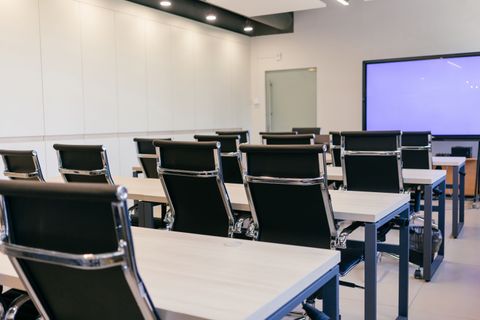
This approach can be relevant when an organization is establishing a new office, expanding into another location, creating a temporary workspace, preparing a project office, or changing its workplace layout.
Business office furniture commonly includes:
Work desks and benching systems
Ergonomic office chairs
Reception desks
Filing and storage units
Conference tables
Meeting chairs
Training-room furniture
Workstations
Lounge seating
Office partitions
Selected office equipment
An office furniture package may combine several related items into one planned configuration. For example, a package for a small workplace could contain desks, chairs, storage units, and meeting furniture.
An office chair rental arrangement focuses specifically on seating, while an office desk rental arrangement covers workstations or individual desks. Larger requirements can involve complete corporate office furniture configurations.
The concept exists because workplace requirements can change. Organizations may not always need the same quantity or configuration of furniture throughout the life of an office.
Why Office Furniture Rentals Matter Today
Modern workplaces are becoming more flexible. Companies may use hybrid working arrangements, project teams, shared work areas, satellite offices, temporary project locations, or flexible workspace environments.
This creates a need for furniture planning that can adapt to changing occupancy.
India's office market remained particularly active during 2026. CBRE reported that office absorption reached approximately 20.7 million square feet in Q1 2026, the strongest January-March performance recorded in its series. Bengaluru, Delhi-NCR, and Mumbai accounted for 67% of the activity.
By Q2 2026, quarterly office absorption reached approximately 24.6 million square feet, while flexible workspace operators represented 27% of leasing activity.
These trends matter to furniture planning because expanding offices need practical ways to equip new work areas.
Office furniture rentals can be particularly relevant to:
Startups establishing initial workplaces
Companies expanding into additional offices
Businesses managing temporary projects
Organizations testing different workplace layouts
Training and conference facilities
Event and exhibition offices
Companies undergoing office renovation
Hybrid workplaces with changing occupancy
The main planning challenge is not simply selecting furniture. It involves matching furniture quantities, dimensions, ergonomics, room layouts, delivery schedules, and workplace requirements.
Types of Office Furniture
Different areas of an office require different furniture configurations.
| Office area | Common furniture | Main planning consideration |
|---|---|---|
| Individual work area | Desk and office chair | Ergonomics and available space |
| Open workspace | Bench desks and task chairs | Density and movement |
| Manager's office | Desk, chair, storage | Space and functionality |
| Conference room | Table and meeting chairs | Seating capacity |
| Reception | Reception desk and seating | Visitor movement |
| Training room | Tables and chairs | Flexible arrangement |
| Break area | Tables and lounge seating | Comfort and circulation |
| Storage area | Cabinets and shelving | Organization and access |
Corporate office furniture usually requires greater consistency in dimensions, appearance, workstation configuration, and workplace planning.
For a smaller workplace, a basic office furniture package may be easier to plan because the number of desks and chairs can be matched to the expected workforce.
For a larger organization, furniture may need to be divided into zones such as individual workstations, collaboration areas, meeting rooms, reception areas, and quiet spaces.
Office Furniture Delivery and Installation Planning
Office furniture delivery is an important logistical consideration because furniture dimensions can affect elevators, doors, corridors, staircases, and loading areas.
Before scheduling delivery, organizations can prepare a simple checklist:
Confirm building access hours
Measure elevators and doorways
Check loading-bay restrictions
Confirm floor protection requirements
Identify the destination room for each item
Prepare an inventory list
Check assembly requirements
Coordinate with building management
Keep a record of delivered items
Inspect furniture for visible damage
Large desks and conference tables can be particularly difficult to move through narrow corridors.
For multi-floor offices, labeling furniture according to floor, room, and workstation number can reduce confusion during installation.
Recent Developments in India's Office Market
Several developments during 2026 have influenced workplace planning.
On 20 February 2026, CBRE announced the introduction of FlexGrade in India, reflecting increasing attention to quality, consistency, and transparency within flexible workspace environments.
On 24 March 2026, CBRE's Flex-plosion: India's Flexible Workspaces Era report described flexible workspaces as an increasingly important component of corporate real-estate strategy. It highlighted a shift toward quality, identity, flexibility, and operational efficiency.
On 20 August 2026, CBRE reported that 77% of surveyed office occupiers expected their India office portfolios to expand over the following two years. The survey also found that 67% expected flexible workspaces to form part of their portfolios during that period.
The latest Q3 2026 office figures, published on 1 October 2026, reported approximately 21 million square feet of quarterly absorption and a record 66.4 million square feet for the first nine months of 2026. Flexible workspace operators accounted for 24% of quarterly leasing activity.
These developments suggest that office furniture planning increasingly needs to accommodate flexibility and changing workplace formats.
A simplified view of the trend is:
| 2026 period | India office absorption | Notable development |
|---|---|---|
| Q1 | ~20.7 million sq. ft. | Strongest Q1 recorded |
| Q2 | ~24.6 million sq. ft. | Record quarterly activity |
| Q3 | ~21.0 million sq. ft. | Continued strong momentum |
| Jan–Sep | ~66.4 million sq. ft. | Highest nine-month total |
The figures describe office-market activity rather than furniture demand directly, but they provide useful context for workplace planning.
Office Furniture Rental Near Me: What to Check
The phrase office furniture rental near me is commonly used when organizations are looking for nearby options. Location can matter because transportation distance, building access, delivery timing, and regional inventory can influence the practicality of an arrangement.
Instead of choosing an option solely because it appears nearby, businesses should compare:
Furniture specifications
Available quantities
Delivery coverage
Assembly arrangements
Contract duration
Replacement conditions
Maintenance responsibilities
Damage and return policies
Documentation
Applicable taxes
A nearby provider may be convenient, but the furniture still needs to meet the workplace's ergonomic and dimensional requirements.
Laws, Standards, and Policies in India
Office furniture is affected by India's product standards, taxation framework, workplace safety requirements, and contractual rules.
The Furniture Quality Control Order, 2025 introduced mandatory quality requirements for specified furniture categories. The framework has been amended during 2026. A February 12, 2026 amendment, for example, addressed certain research-and-development imports and related conditions.
BIS states that some products are subject to mandatory Indian Standards through Quality Control Orders when the Central Government determines that compulsory compliance is necessary for areas such as safety, public interest, environmental protection, or prevention of unfair practices.
Relevant furniture standards can cover categories such as work chairs, general-purpose chairs and stools, tables and desks, and storage units. However, the applicable standard depends on the exact product category.
Tax treatment is another consideration. CBIC's GST schedule places most furniture under heading 9403, with the listed standard rate for other furniture shown as 18%, subject to classification and applicable exceptions.
Workplace safety also matters. India's four Labour Codes, including the Occupational Safety, Health and Working Conditions Code, 2020, came into effect on 21 November 2025, according to the Ministry of Labour and Employment. The framework consolidates multiple labour laws and addresses workplace health, safety, and working conditions.
For office planning, this reinforces the importance of maintaining appropriate workplace conditions. Furniture selection should therefore consider stability, safe movement, suitable seating, clear walkways, and ergonomic workplace design.
Tools and Resources for Office Furniture Planning
Businesses can use several practical tools when preparing an office furniture plan.
Office floor-plan software: Digital planning applications can map desks, chairs, meeting tables, storage, walkways, doors, and other fixed elements.
Measurement tools: Laser distance meters and measuring tapes help confirm room dimensions, ceiling heights, door widths, elevator dimensions, and corridor clearances.
Furniture specification sheets: These can record dimensions, materials, load limits, adjustment ranges, assembly requirements, and maintenance instructions.
Inventory spreadsheets: A spreadsheet can track item descriptions, quantities, room assignments, identification numbers, delivery status, and return dates.
Ergonomic checklists: These can help evaluate chair height, desk height, monitor position, legroom, posture, and movement space.
BIS resources: The BIS website provides information about applicable Indian Standards, Quality Control Orders, certification, and related documentation.
A basic planning worksheet might look like this:
| Planning item | Information to record |
|---|---|
| Furniture type | Desk, chair, table, cabinet |
| Quantity | Number required |
| Location | Floor and room |
| Dimensions | Width, depth, height |
| Ergonomics | Adjustable features |
| Delivery | Planned date and access route |
| Condition | New, refurbished, or previously used |
| Documentation | Agreement and inventory record |
| Return | Date and condition requirements |
Choosing Office Furniture Packages
An office furniture package can simplify planning when several furniture categories are required together.
However, businesses should compare the individual components rather than assuming that every package is suitable.
A suitable package should match:
Number of employees
Office dimensions
Work style
Meeting requirements
Storage needs
Ergonomic expectations
Design preferences
Contract duration
Delivery requirements
For example, a technology company with mostly individual workstations may need more desks and task chairs, while a consulting office may require additional conference and collaboration furniture.
A conference room furniture rental arrangement should also account for table dimensions, seating capacity, presentation equipment, power access, and movement around the room.
Practical Checklist for Office Furniture Rental
Before entering an arrangement, organizations can review the following points:
Measure every relevant room
Estimate actual workstation requirements
Identify furniture standards that may apply
Check chair and desk specifications
Review inventory quantities
Confirm delivery access
Record furniture condition
Understand maintenance responsibilities
Review replacement and damage clauses
Confirm applicable taxes
Keep copies of all documentation
Plan the return or transition process
This approach helps reduce mismatches between the furniture ordered and the actual workplace environment.
Frequently Asked Questions
What is office furniture rental?
It is an arrangement in which an organization uses office furniture for an agreed period rather than permanently retaining the furniture. It can include desks, chairs, tables, storage units, and conference-room furniture.
What is usually included in an office furniture package?
Packages vary. They may contain desks, chairs, storage units, meeting tables, or other workplace furniture. The exact inventory should always be documented before an arrangement begins.
Is office chair rental suitable for temporary offices?
It can be practical when seating is needed for a defined period, such as a temporary project, training area, expansion phase, or short-term workplace. Ergonomic specifications should still be checked carefully.
What should businesses check before office furniture delivery?
They should confirm building access, loading areas, elevator dimensions, door widths, delivery timing, assembly requirements, room assignments, and inventory documentation.
Does Indian law regulate office furniture?
Certain furniture categories are subject to Indian Standards and Quality Control Orders. Workplace safety and taxation rules may also apply depending on the circumstances. The exact requirements depend on the furniture category and business arrangement.
Conclusion
Office furniture rentals provide a flexible way for organizations to equip workplaces when furniture requirements may change over time. The concept can cover office chairs, desks, workstations, conference tables, storage units, and selected office equipment.
India's office market showed strong momentum throughout 2026, with record or near-record activity across several quarters and growing adoption of flexible workplace models. These developments make adaptable office planning increasingly relevant.
Businesses considering an office furniture rental arrangement should focus on practical requirements rather than appearance alone. Dimensions, ergonomics, workplace layout, delivery access, documentation, furniture condition, and applicable standards all deserve attention.
Government regulations also matter. BIS quality-control requirements apply to specified furniture categories, GST classification affects applicable taxation, and India's workplace safety framework establishes broader expectations for safe working environments.
A well-organized furniture plan can therefore begin with a simple process: measure the space, identify the required furniture, check applicable standards, document the inventory, plan delivery, and review the agreement carefully. This creates a clearer foundation for managing changing workplace needs while maintaining a functional and safe office environment.