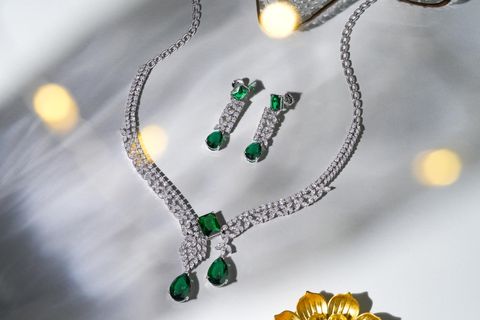
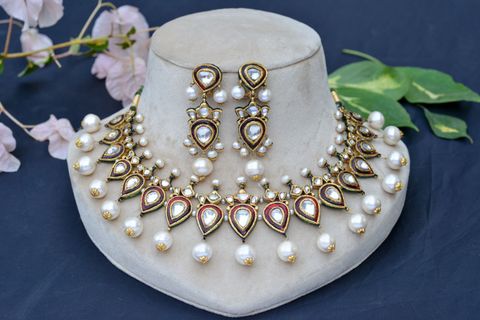
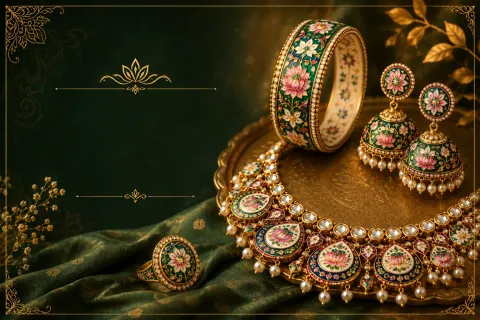
Polki Jewellery Collection: Explore Styles, Designs, Insights, and Useful Resources
Polki jewellery is a traditional Indian jewellery style known for its use of uncut, often minimally processed diamonds set in decorative metal frameworks. It is closely associated with heritage craftsmanship, particularly the Jadau jewellery tradition of Rajasthan and parts of North India.
Unlike conventional faceted diamond jewellery, Polki pieces generally retain the natural appearance of uncut diamond surfaces. The stones may have irregular shapes and a softer, less uniform appearance. They are often arranged in gold settings and combined with coloured gemstones, pearls, enamel work, and intricate decorative details.
A polki jewellery collection can include necklaces, earrings, bangles, rings, pendants, maang tikkas, hathphools, and coordinated bridal ornaments.
The style exists because traditional Indian jewellery developed around regional techniques, ceremonial clothing, royal patronage, and the use of precious materials. Today, Polki designs bring these historical influences into contemporary wedding and occasion wear.
Why Polki Jewellery Remains Important
Polki jewellery represents more than a decorative style. It connects traditional craftsmanship with family customs, regional identity, and modern fashion preferences.
Its importance can be understood through several factors:
Cultural heritage: Traditional designs reflect generations of Indian jewellery-making techniques.
Wedding traditions: Polki ornaments are frequently associated with bridal clothing and ceremonial occasions.
Craftsmanship: Intricate settings and detailed arrangements require specialized jewellery-making skills.
Design flexibility: Polki can be combined with pearls, coloured stones, enamel, and different gold finishes.
Contemporary styling: Modern interpretations can be worn with traditional outfits as well as selected fusion clothing.
Heirloom appeal: Some families preserve traditional jewellery across generations.
For designers and jewellery researchers, understanding Polki also helps distinguish it from Kundan, Meenakari, and conventional diamond jewellery.
Popular Polki Jewellery Designs
Polki jewellery designs vary according to stone arrangement, metalwork, colour combinations, and regional influences. Some pieces have elaborate traditional detailing, while others use simpler arrangements.
Common design categories include:
| Design Type | Main Characteristics | Common Occasion |
|---|---|---|
| Polki necklace | Uncut stones arranged in decorative patterns | Weddings and celebrations |
| Choker | Short necklace positioned close to the neck | Bridal ceremonies |
| Rani haar | Long necklace with traditional detailing | Formal occasions |
| Polki earrings | Studs, drops, chandbalis, and jhumkas | Weddings and festivals |
| Polki bangles | Decorative stone settings around the wrist | Ceremonial wear |
| Polki maang tikka | Forehead ornament with traditional motifs | Bridal styling |
| Polki rings | Single-stone or clustered arrangements | Special occasions |
| Hathphool | Hand ornament connecting rings and bracelets | Bridal wear |
The choice of design usually depends on clothing, face shape, neckline, hairstyle, comfort, and the overall visual balance of an outfit.
Traditional Polki Jewellery and Its Craftsmanship
Traditional polki jewellery is often associated with Jadau craftsmanship. In this technique, stones are arranged within carefully prepared settings, with metalwork designed to hold the components securely.
The process may involve several stages:
Selecting and assessing the stones
Planning the jewellery pattern
Preparing the metal framework
Positioning the uncut stones
Securing the stones within the setting
Adding decorative elements
Completing finishing and quality checks
Some traditional pieces also include Meenakari enamel work on the reverse side. This creates additional decorative detail that may not be immediately visible when the jewellery is worn.
The terms Polki, Kundan, and Jadau are sometimes used together, but they do not describe exactly the same thing. Polki generally refers to the uncut diamond material, Kundan is associated with a traditional stone-setting technique, and Jadau describes a broader style of jewellery craftsmanship.
Bridal Polki Jewellery Collection
A bridal polki jewellery collection often includes coordinated pieces designed for different wedding ceremonies.
A traditional bridal arrangement may contain:
A statement necklace
Matching earrings
Maang tikka
Nath or nose ornament
Bangles or kadas
Hathphool
Rings
Waist belt or kamarbandh
Some brides prefer a complete matching set, while others combine a Polki necklace with contrasting gemstone earrings or simpler accessories.
For a balanced bridal appearance, it helps to consider the outfit's neckline, embroidery, colour, and overall visual weight. A heavily decorated necklace may work well with a simpler blouse neckline, while a detailed outfit may suit a more restrained jewellery arrangement.
Comfort is also important. Large earrings, layered necklaces, and elaborate head ornaments can become difficult to wear during long ceremonies. Weight, fastening quality, and skin contact should therefore be considered alongside appearance.
Latest Polki Jewellery Designs and 2026 Trends
Polki jewellery continues to appear in contemporary Indian bridal styling, with recent trends showing a combination of heritage detailing and more adaptable designs.
An article published by the Indian Institute of Gems & Jewellery on 27 May 2026 highlighted the continuing relevance of Polki and Kundan chokers, layered necklaces, refined antique finishes, lighter designs, detachable elements, and jewellery intended for repeated use. <Cite refs={["turn735755search0"]}/>
Some emerging design directions include:
Pastel combinations: Polki with softer shades such as blush, mint, ivory, and powder blue.
Layered necklaces: Combining different necklace lengths for a coordinated appearance.
Lightweight arrangements: Reducing unnecessary bulk while retaining traditional visual elements.
Detachable components: Designing earrings or pendants that can be styled in different ways.
Vintage-inspired details: Using antique finishes and traditional motifs.
Mixed gemstones: Combining Polki with emeralds, rubies, pearls, or other coloured stones.
Contemporary silhouettes: Pairing traditional stone settings with cleaner, more modern outlines.
These are design directions rather than rules. Traditional red, green, and gold combinations remain relevant, and personal preference continues to influence jewellery selection.
Understanding Polki Earrings Designs
Polki earrings designs range from compact everyday-inspired pieces to elaborate bridal ornaments.
Common styles include:
Polki studs
Chandbali earrings
Jhumka designs
Drop earrings
Floral clusters
Crescent-shaped earrings
Pearl-accented earrings
Long layered bridal earrings
Smaller earrings can be easier to wear for extended periods. Larger designs may create a stronger visual effect but should be checked for weight, fastening strength, and comfort.
Earring selection can also depend on hairstyle and outfit. For example, chandbalis may complement traditional clothing, while compact studs can work with more detailed necklaces.
Understanding a Polki Jewellery Set
A polki jewellery set usually refers to coordinated ornaments designed around a common pattern, stone arrangement, or metal finish.
A set may include:
Necklace and earrings
Necklace, earrings, and maang tikka
Choker and matching drops
Necklace with bangles
A complete bridal jewellery arrangement
Before choosing a coordinated set, compare the stone shapes, colour consistency, metal finish, fastening design, and overall proportions. Matching pieces do not necessarily need to be identical; they should create a visually balanced combination.
Recent Industry Developments and Craft Preservation
Traditional jewellery craftsmanship remains an important part of India's wider gems and jewellery sector. Industry discussions increasingly include design innovation, skilled craftsmanship, traceability, and changing preferences among younger jewellery audiences.
The 2026 wedding-season discussion published by the Indian Institute of Gems & Jewellery reflects a movement toward combining traditional Polki and Kundan designs with comfort, adaptability, and repeated wear. <Cite refs={["turn735755search0"]}/>
This is relevant to jewellery makers because traditional techniques need to remain recognizable while responding to contemporary clothing, lifestyles, and styling preferences.
Craft documentation, training, and awareness of material characteristics can also help people better understand the difference between traditional workmanship and modern imitations.
Laws and Policies Affecting Jewellery in India
Jewellery made with gold and precious stones is affected by Indian standards and consumer-protection requirements.
The Bureau of Indian Standards (BIS) operates India's hallmarking framework for gold and silver jewellery. Hallmarking helps identify the declared purity or fineness of the precious metal. <Cite refs={["turn735755search1","turn735755search12"]}/>
For hallmarked gold jewellery, the hallmark includes:
BIS Standard Mark
Purity or fineness marking
Six-character alphanumeric Hallmark Unique Identification Number (HUID)
The BIS Care App includes a Verify HUID feature that can be used to check details associated with a hallmarked gold item. <Cite refs={["turn735755search1","turn735755search4"]}/>
There were also updates to mandatory hallmarking coverage during 2026. The sixth phase took effect on 2 March 2026, adding seven districts and bringing the total number of covered districts to 380, according to a Ministry of Consumer Affairs press release dated 13 March 2026. <Cite refs={["turn735755search9","turn735755search28"]}/>
It is important to understand that gold hallmarking verifies the declared purity of the gold component. It does not independently establish the natural origin, quality, or authenticity of every diamond or coloured stone in a Polki ornament.
For stone-related information, documentation from a recognized gem-testing laboratory may be relevant. Buyers and jewellery owners should check what a report actually covers rather than assuming it certifies every component.
Useful Tools and Resources
Several resources can help people research Polki jewellery and understand its materials.
BIS Care App: Includes the HUID verification feature for hallmarked gold jewellery. <Cite refs={["turn735755search4"]}/>
BIS Hallmarking Information: Explains gold and silver hallmarking, purity marks, HUID, and applicable standards. <Cite refs={["turn735755search1","turn735755search2"]}/>
Gemstone identification resources: Educational material from recognized gemological institutions can help explain diamond characteristics, treatments, and gemstone identification.
Jewellery comparison checklist: A simple spreadsheet can record metal purity, stone details, weight, dimensions, design, hallmark information, and available documentation.
Jewellery-care guide: Keep a record of recommended cleaning methods, storage conditions, inspection dates, and repair history.
Design reference board: Collect photographs of necklace shapes, earrings, motifs, gemstone colours, and traditional settings to compare different design directions.
Jewellery Care and Storage Best Practices
Polki jewellery often contains delicate settings and uncut stones. Careful handling can help maintain its appearance and reduce the risk of damage.
Recommended practices include:
Store each ornament separately in a soft-lined box.
Keep jewellery away from excessive moisture.
Avoid direct contact with perfumes and cosmetics.
Do not use harsh household chemicals.
Avoid soaking delicate pieces in cleaning solutions.
Use a soft cloth for gentle surface cleaning when appropriate.
Have loose stones and clasps inspected by a qualified professional.
Keep jewellery away from hard surfaces that may cause scratches.
Follow material-specific care instructions.
Traditional settings may require more careful handling than simpler jewellery designs. If the construction or stone treatment is unknown, avoid experimenting with home-cleaning methods.
Frequently Asked Questions
What is Polki jewellery?
Polki jewellery is a traditional Indian style that uses uncut, often minimally processed diamonds in decorative settings. It is commonly associated with Jadau craftsmanship and may include gold, pearls, enamel, and coloured gemstones.
What is the difference between Polki and Kundan jewellery?
Polki generally refers to the uncut diamond material used in an ornament, while Kundan refers to a traditional stone-setting technique. The terms are sometimes used together because both appear in related Indian jewellery traditions.
What is usually included in a bridal Polki jewellery collection?
A bridal collection may include a necklace, earrings, maang tikka, bangles, rings, nath, and hathphool. The exact combination depends on the outfit and the ceremonies.
How can someone check the hallmark on Polki jewellery?
For hallmarked gold jewellery, check the BIS mark, purity marking, and six-character HUID. The HUID can be verified through the BIS Care App. This checks the hallmarked gold item's details, not the independent authenticity of every stone.
How should Polki jewellery be stored?
Store pieces separately in soft-lined boxes, keep them dry, avoid harsh chemicals, and arrange periodic inspections of stone settings and clasps.
Conclusion
A Polki jewellery collection brings together traditional Indian craftsmanship, uncut diamond designs, decorative metalwork, and contemporary styling. Its range includes necklaces, earrings, bridal sets, bangles, and other ornaments suited to weddings and special occasions.
Recent 2026 design discussions highlight a combination of heritage-inspired detailing, pastel colours, lighter arrangements, layered necklaces, and adaptable jewellery. At the same time, India's BIS hallmarking framework provides a way to verify the declared purity of gold used in covered jewellery items.
Understanding the difference between Polki, Kundan, and Jadau, checking material documentation, and following suitable care practices can help readers make more informed assessments of traditional jewellery.
Disclaimer: This article is intended solely for general educational and informational purposes. It does not claim to authenticate, certify, appraise, or guarantee any jewellery, gemstone, material, or design. It is not intended to sell, advertise, or promote any product, brand, manufacturer, or retailer. Readers should independently verify jewellery details, hallmark information, and gemstone documentation through appropriate authorities or qualified professionals.

Related Post...
Lac Bangles Designs: Explore Styles, Trends, Insights, Suggestions, and Useful Resources
Updated: November 03, 2026
Read More
Lightweight Gold Jewellery: Explore Styles, Trends, Insights, Suggestions, and Useful Resources
Updated: November 03, 2026
Read More
Rose Gold Jewellery: Explore Overview, Basics, Explanation, Knowledge, and Key Details
Updated: November 04, 2026
Read More