Direct-to-Film Printing Machines: Complete Guide to Basics, Technologies, Processes, Facts, and Best Practices
Direct-to-film (DTF) printing is a digital textile decoration method used to transfer printed designs from a special film onto garments and other compatible fabrics. It has become an important option for customised clothing, promotional textiles, sportswear, and garment decoration because it supports detailed artwork and a wide range of fabric types.
A DTF printing machine prints designs onto a coated transfer film using textile pigment inks. A hot-melt adhesive powder is then applied to the printed area, cured using heat, and transferred onto the fabric with a heat press.
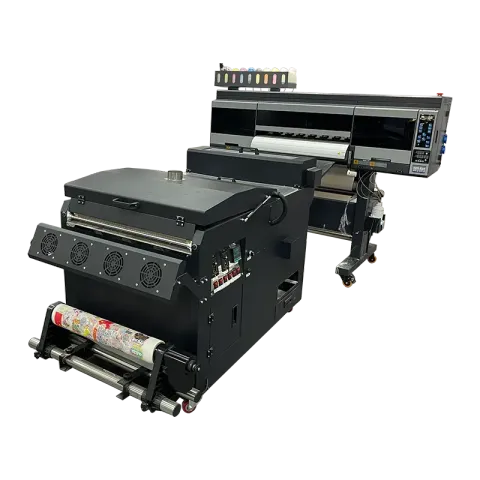
Modern equipment ranges from compact printers for smaller production runs to an industrial DTF printing machine with automated film feeding, powder application, and curing. A roll to roll DTF printer can process continuous film rolls, making it suitable for longer production runs.
This guide explains DTF printing basics, machine types, technologies, equipment, applications, selection factors, recent developments, and relevant considerations for operators in India.
1. What Is a DTF Printing Machine?
A DTF printing machine is a digital inkjet printer designed to print artwork onto specially coated polyethylene terephthalate (PET) transfer film. The printed design is subsequently transferred to fabric through a heat-activated adhesive process.
Unlike direct-to-garment printing, which deposits ink directly onto clothing, DTF creates a transfer on film first. This transfer can then be applied to suitable garments using a heat press.
A complete DTF printing setup generally includes:
DTF inkjet printer
Coated PET transfer film
CMYK and white textile pigment inks
Hot-melt adhesive powder
Powder application equipment
Curing oven or integrated heating unit
Heat press
RIP software and colour management tools
Cleaning and maintenance materials
The printer is only one part of the production system. Consistent results depend on coordinating the ink, film, adhesive, curing process, and heat-transfer equipment.
2. How Direct-to-Film Printing Works
The DTF printing process generally follows five main stages.
Artwork preparation: The design is prepared using graphic design software and processed through RIP software. The artwork is commonly mirrored before printing.
Film printing: The printer deposits CMYK colour ink and a white ink layer onto the coated side of the PET film. The white layer provides an opaque base, especially for dark fabrics.
Powder application: Hot-melt adhesive powder is distributed over the printed ink while it is still suitable for receiving the adhesive. Excess powder is removed.
Curing: The printed film passes through a curing oven or heating unit. Heat melts the adhesive powder and prepares the transfer for fabric application.
Heat pressing and peeling: The cured transfer is positioned on the garment and pressed under specified conditions. The carrier film is peeled according to its hot-peel or cold-peel characteristics.
Temperature, pressure, and processing time vary with the film, adhesive, fabric, and equipment. Operators should follow the consumable manufacturer's instructions and validate settings through sample tests.
3. Main Components of DTF Printing Equipment
Component | Main function |
|---|---|
Printhead | Deposits controlled ink droplets onto the film |
Ink delivery system | Supplies CMYK and white inks |
Film feeding mechanism | Moves PET film through the printer |
RIP software | Processes artwork and print instructions |
Powder shaker | Applies adhesive powder evenly |
Powder recovery system | Collects excess adhesive powder |
Curing oven | Melts the adhesive powder |
Heat press | Transfers the design onto fabric |
Take-up unit | Collects printed film rolls |
Maintenance station | Supports printhead cleaning and upkeep |
Printhead
The printhead controls ink droplet placement and influences image detail, colour consistency, and production speed. Nozzle condition and correct ink compatibility are important for reliable printing.
White Ink Circulation System
White ink is essential for producing opaque designs on dark and coloured fabrics. Because white pigment can settle, many DTF systems use ink circulation or agitation mechanisms to help maintain ink consistency.
Powder Shaker and Curing Unit
Automated systems distribute adhesive powder and remove excess material before curing. Integrated units can reduce manual handling and help maintain a more consistent production sequence.
4. Types of Direct-to-Film Printing Machines
DTF printers are available in different formats to support different print widths, production volumes, and workflows.
4.1 Desktop DTF Printing Machine
A desktop DTF printing machine is a compact option for smaller print operations. It is commonly used for customised T-shirts, small garment designs, sample transfers, and limited production runs.
Its main characteristics include:
Compact design and smaller print width
Relatively simple film handling
Manual or semi-automatic powder application
Compatibility with a separate heat press
4.2 Industrial DTF Printing Machine
An industrial DTF printing machine is designed for higher-volume garment decoration. It may include multiple printheads, bulk ink systems, automated film feeding, and integrated powder application and curing units.
Industrial configurations can support longer operating periods and more consistent workflows when maintained correctly.
4.3 Roll to Roll DTF Printer
A roll to roll DTF printer processes continuous rolls of PET transfer film. The film passes through printing, powder application, and curing stages, depending on whether the system is integrated or uses separate equipment.
Common features include:
Continuous film feeding
Automatic take-up systems
Adjustable media tension
Integrated or connected powder shaker
Inline heating and curing
These systems are useful for repeat designs, gang sheets, and longer production runs.
4.4 DTF Transfer Film Printer
A DTF transfer film printer is a printer configured specifically for printing onto coated transfer film. It may be a compact sheet-fed model or a roll-fed system.
The printer must be compatible with the film coating and the selected ink formulation. Using unsuitable film or ink can cause poor ink adhesion, uneven powder application, or inconsistent transfer quality.
4.5 DTF Printer for T-Shirt Printing
A DTF printer for T-shirt printing is configured to produce garment-ready transfers. It generally uses CMYK and white inks to create designs for light, dark, and coloured fabrics.
The final result depends on the complete system, including film, adhesive powder, curing, fabric composition, and heat-press settings.
4.6 Wide-Format DTF Systems
Wide-format DTF systems support larger film widths and can print multiple designs across a sheet or continuous roll. They are useful for larger garment graphics, gang sheets, and commercial transfer workflows.
5. Materials Used in DTF Printing
DTF printing relies on compatible consumables. Each material has a specific role in the transfer process.
Material | Purpose |
|---|---|
PET transfer film | Carries the printed design before transfer |
CMYK pigment ink | Creates the coloured artwork |
White pigment ink | Creates an opaque base layer |
Hot-melt adhesive powder | Bonds the printed design to fabric |
Cleaning solution | Supports printhead and ink-system maintenance |
Protective cover sheet | Helps protect the garment during pressing |
Transfer Film
DTF film is commonly made from PET and has a special coating that accepts the ink. Film varieties include hot-peel, cold-peel, and selected instant-peel types.
The correct choice depends on the printer, adhesive, fabric, and transfer workflow.
Adhesive Powder
Hot-melt adhesive powder is applied to the wet printed design. When heated, it melts and forms the bonding layer between the printed image and the textile.
Powder characteristics, such as particle size and flexibility, can influence the finished transfer's feel and performance.
DTF Ink
Most systems use CMYK colours together with white pigment ink. The white layer is particularly important when printing designs intended for dark garments.
6. Technologies Used in Modern DTF Printing
Inkjet Printing Technology
Inkjet printheads deposit small ink droplets onto the transfer film. Print resolution, pass count, nozzle condition, and ink compatibility influence image detail and output consistency.
RIP and Colour Management Software
Raster Image Processor (RIP) software converts artwork into printer instructions. It can manage:
Colour profiles and ink limits
White ink generation
Image mirroring
Print resolution and pass settings
Artwork placement and nesting
Gang-sheet layouts
Correct colour management helps maintain consistency between the digital design and the transferred image.
Automated Powder Application
Automatic powder shakers distribute adhesive over the printed film and remove excess material. This can reduce manual handling and improve repeatability.
Integrated Curing Systems
Inline curing systems heat the adhesive powder as the film moves through the machine. Temperature and exposure settings must be matched to the specific ink, film, and powder combination.
White Ink Circulation
White pigment can settle during periods of inactivity. Circulation, stirring, and suitable maintenance routines help maintain a more consistent ink supply and reduce the risk of nozzle problems.
7. Applications of DTF Printing Machines
DTF technology is used in garment decoration and several textile-related applications.
Industry | Common applications |
|---|---|
Apparel | T-shirts, hoodies, sweatshirts |
Sportswear | Jerseys, training clothing, team uniforms |
Fashion | Printed designs, customised garments |
Promotional textiles | Event clothing and branded fabric items |
Accessories | Tote bags, caps, fabric accessories |
Workwear | Uniforms and selected polyester or cotton garments |
Small garment workshops | Personalised clothing and short design runs |
DTF can be used on many cotton, polyester, and blended fabrics, subject to compatibility testing. Performance varies with fabric construction, adhesive selection, transfer settings, and garment care.
8. Advantages and Limitations of DTF Printing
Advantages
Fabric flexibility: Suitable for many cotton, polyester, and blended fabrics.
Detailed artwork: Supports complex graphics, gradients, and multicolour designs.
Dark garment compatibility: White ink creates an opaque base for coloured and dark textiles.
No screen preparation: Digital artwork can be changed without preparing a new printing screen.
No conventional fabric pretreatment: The transfer process generally does not require the pretreatment used by some direct-to-garment systems.
Batch flexibility: Designs can be arranged together on gang sheets to improve film utilisation.
Transfer storage: Properly prepared transfers can be stored for later garment application, subject to film and consumable guidance.
Limitations
Multiple process stages: Printing, powdering, curing, and pressing must be coordinated.
Consumable compatibility: Incorrect combinations of ink, film, and powder can affect transfer quality.
Maintenance requirements: Printheads and white ink systems need regular attention.
Transfer feel: The printed design may feel like a distinct layer on the garment.
Heat sensitivity: Incorrect curing or pressing conditions can damage film, fabric, or artwork.
Ventilation requirements: Powder handling and heated adhesive processes require suitable workplace controls.
9. Factors to Consider When Selecting DTF Printing Equipment
Choosing a machine requires evaluating the complete workflow rather than the printer alone.
Print width: Select a suitable width for the garment designs and film sizes.
Production volume: Match the printer and curing equipment to expected daily output.
Printhead configuration: Examine nozzle technology, print resolution, and maintenance requirements.
White ink management: Check circulation, stirring, and cleaning features.
Film compatibility: Confirm support for the intended PET film type.
Powder application: Decide between manual powdering and an automated shaker.
Curing capacity: Ensure that the heating system can handle the printer's output.
Heat press capacity: Match platen dimensions and operating characteristics to the garment range.
RIP software: Review white ink generation, colour profiles, and gang-sheet features.
Maintenance support: Check technical documentation, spare parts, and operator training.
Workspace requirements: Plan for ventilation, electrical supply, safe powder storage, and adequate operating space.
An entry-level printer may be suitable for limited garment work, while a roll-to-roll industrial system may be more appropriate for continuous transfer production.
10. Recent Developments and Industry Trends
DTF technology is moving towards more automated, integrated, and higher-productivity workflows.
Increased Automation
Recent industry developments include integrated printing, powder application, and curing systems. Manufacturers are focusing on reducing manual handling, improving consistency, and limiting production interruptions.
New Roll-to-Roll Systems
Newer roll-fed systems are designed for continuous transfer production. Improvements in media handling, heating controls, and workflow integration are helping printing operations manage larger print volumes.
Improved Consumable Development
Film coatings, pigment inks, and hot-melt adhesive powders continue to develop. Their compatibility is important for achieving suitable adhesion, flexibility, and wash performance.
Digital Workflow Integration
RIP software and automated artwork preparation tools are making it easier to arrange multiple designs, manage colour profiles, and prepare print files for different garment sizes.
11. Indian Regulations and Workplace Safety
DTF printing operations in India should consider applicable factory safety, environmental requirements, and local permissions. The exact requirements depend on the nature and scale of the operation.
Factories Act, 1948
Where applicable, the Factories Act, 1948 addresses workplace safety and health. Relevant provisions include:
Section 13: Ventilation and temperature
Section 14: Dust and fume control
Section 21: Fencing of machinery
Section 38: Fire precautions
These provisions are relevant when assessing ventilation, heated equipment, moving rollers, and powder-handling areas. Applicable state factory rules should also be checked.
Plastic Waste Management Rules, 2016
DTF operations can generate discarded PET transfer film and other plastic waste. The Plastic Waste Management Rules, 2016, as amended, establish requirements for plastic waste management. Businesses should segregate waste and use appropriate authorised collection or recycling channels.
The rules also contain specific Extended Producer Responsibility requirements for covered plastic packaging. Applicability depends on the business's role and the type of plastic material involved; transfer film should not automatically be treated as plastic packaging.
Environmental and Process Controls
CPCB guidance for textile processing highlights equipment safety, appropriate handling of chemicals, process controls, and personal protective equipment. Individual DTF operations should assess their actual consumables and processes rather than assume that all textile-printing rules apply identically.
12. Best Practices for Operating DTF Printing Machines
Use ink, film, and adhesive powder that are compatible with the printer.
Check printhead nozzles before starting a production run.
Maintain white ink circulation according to the machine manual.
Keep transfer film clean and protected from moisture and dust.
Apply adhesive powder evenly and remove excess material.
Follow the recommended curing temperature and duration.
Test transfers on sample fabric before larger production runs.
Use appropriate heat-press settings for each garment type.
Follow the specified hot-peel or cold-peel procedure.
Inspect transferred designs for adhesion, cracks, and uneven edges.
Clean printheads, wipers, and maintenance stations regularly.
Provide suitable ventilation and safe powder-handling arrangements.
Keep records of consumable batches, machine settings, and maintenance.
13. Tools and Resources for Learning DTF Printing
Resource | Main purpose |
|---|---|
Digital printing and DTF technical guidance | |
DTF printers and textile printing technology | |
Digital printing systems and technical information | |
Artwork preparation and image editing | |
Vector artwork and garment design | |
Environmental guidance and waste management | |
Indian standards and conformity information |
14. Frequently Asked Questions
1. What is a DTF printing machine used for?
A DTF printing machine prints designs onto coated PET transfer film. The design is coated with adhesive powder, cured, and transferred onto garments using a heat press.
2. What is the difference between DTF and sublimation printing?
DTF uses printed transfer film and hot-melt adhesive to apply designs to fabric. Sublimation uses heat-activated dye that penetrates polyester fibres or compatible polymer coatings. DTF supports a wider range of fabric types, including cotton.
3. What equipment is required for DTF printing?
A typical setup requires a DTF printer, PET transfer film, CMYK and white inks, adhesive powder, a curing system, a heat press, and RIP software.
4. What is a roll to roll DTF printer?
A roll to roll DTF printer uses continuous PET film rolls rather than individual sheets. It is designed for longer print runs and can be connected to automatic powder application and curing equipment.
5. Can a DTF printer be used for T-shirt printing?
Yes. A DTF printer for T-shirt printing creates transfers that can be applied to suitable cotton, polyester, and blended garments. The fabric and consumables should be tested for compatibility and durability.
Conclusion
Direct-to-film printing machines have become useful tools for garment decoration, customised apparel, sportswear, and textile printing. Their ability to transfer detailed designs onto different fabric types makes them suitable for both smaller workshops and larger production environments.
From a compact DTF transfer film printer to an industrial DTF printing machine, equipment selection should consider print width, printhead technology, ink management, powder application, curing capacity, and heat-transfer requirements.
Consistent output depends on using compatible consumables, maintaining accurate process settings, caring for the printhead, and following appropriate workplace safety practices. A well-planned DTF printing workflow can support reliable and organised garment decoration.
Disclaimer: This article is intended for general informational and educational purposes only. Machine specifications, consumable requirements, operating procedures, and applicable regulations may vary. Consult manufacturer documentation and qualified technical professionals before installing or operating equipment. No results are guaranteed, and this article is not intended to sell or promote any particular product, brand, or organisation.

Related Post...
Sheet Metal Laser Cutting Machines: Explore Overview, Basics, Explanation, Knowledge, and Key Details
Updated: November 23, 2026
Read More
PPC Conversion Tracking: Explore Overview, Basics, Explanation, Knowledge, and Key Details
Updated: November 23, 2026
Read More