Hyundai HE1i Compact EV: Complete Guide to Design, Technologies, Features, Facts, and Best Practices
The Hyundai HE1i electric SUV is an upcoming compact electric vehicle developed specifically for the Indian market. Internally known by the codename HE1i, it is expected to become one of Hyundai Motor India's more accessible electric models, positioned below the Creta Electric.
The vehicle is being developed on Hyundai's E-GMP (K) electric platform, which also underpins the international Hyundai Inster EV. It is planned for production at Hyundai's Sriperumbudur facility in Tamil Nadu.
Hyundai has confirmed two important technology features: Level 2 assisted-driving technology and a next-generation infotainment system. The company also plans to provide Standard Range and Long Range versions.
As of 19 November 2026, the production name, battery capacity, certified driving range, motor output, charging time and complete equipment list have not been officially disclosed. Reports point to a January 2027 debut, within the first-quarter 2027 launch window.
Overview of the Hyundai HE1i Electric SUV
The HE1i is expected to be a sub-four-metre electric SUV designed around Indian driving conditions and market requirements.
Its E-GMP (K) platform is a compact electric vehicle architecture that supports a dedicated battery-powered drivetrain. The international Hyundai Inster provides a technical reference, but the India-specific HE1i may have different dimensions, battery configurations and equipment.
Detail | Available information |
|---|---|
Internal codename | HE1i |
Vehicle category | Compact electric SUV |
Manufacturer | Hyundai Motor India |
Platform | E-GMP (K) |
Production location | Sriperumbudur, Tamil Nadu |
Battery versions | Standard Range and Long Range |
Battery capacity | Not announced |
Driving range | Not announced |
Charging time | Not announced |
Confirmed technology | Level 2 assisted driving and next-generation infotainment |
Expected debut | Q1 2027 |
Production name | Not announced |
The HE1i is expected to compete with compact electric models such as the Tata Nexon EV, Mahindra XUV 3XO EV and Kia Syros EV.
Importance of the Hyundai HE1i
The HE1i could strengthen Hyundai's presence in India's compact electric SUV category. The company currently has larger electric models, including the Creta Electric and Ioniq 5, while the new vehicle is intended to reach a smaller vehicle segment.
Its potential importance includes:
Compact dimensions: A sub-four-metre format may be convenient for city roads and parking.
Dedicated EV architecture: The E-GMP (K) platform is designed for electric propulsion.
Two range choices: Standard Range and Long Range versions are planned.
Advanced driver assistance: Hyundai has confirmed Level 2 assisted-driving technology.
Updated infotainment: A next-generation infotainment system is part of the announced equipment.
Local manufacturing: Production in Tamil Nadu is expected to support Hyundai's India-focused EV programme.
The final usefulness of these features will depend on the production vehicle's specifications, battery performance and equipment levels.
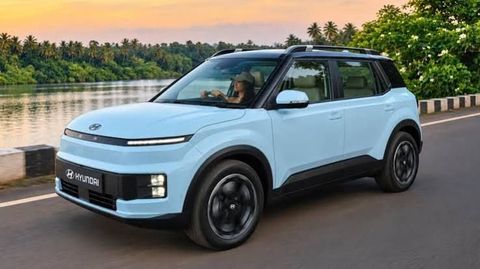
Hyundai HE1i Exterior Design
Recent test vehicles provide some clues about the exterior design, although camouflage still conceals important details.
The prototype appears to have a relatively upright body, a flat-looking roofline, large side windows and pronounced wheel arches. This shape may help provide a practical cabin within a compact footprint.
Reported exterior design elements include:
A boxy compact SUV profile.
Upright front styling.
Geometric alloy wheel designs.
Pronounced wheel-arch cladding.
Roof rails.
Large side windows.
Distinctive front and rear lighting arrangements.
Conventional outside rear-view mirrors.
The latest test photographs show changes in camouflage and provide a clearer view of the rear three-quarter profile. However, the final headlamp design, bumper details, wheel sizes and production lighting signatures remain unconfirmed.
Hyundai HE1i Interior Features
The interior is expected to focus on digital technology and everyday practicality.
Spy photographs have suggested a larger central touchscreen and a relatively slim driver information display. Hyundai has officially confirmed a next-generation infotainment system, but has not released the complete cabin specification.
Expected or reported interior elements include:
A central touchscreen infotainment system.
A digital driver information display.
Connected vehicle functions.
Smartphone connectivity.
Digital battery and range information.
Navigation and charging information.
Practical storage areas.
A compact SUV seating layout.
The infotainment system could use Hyundai's Pleos Connect technology, but the company has not confirmed this specific system for HE1i.
For comparison, the international Hyundai Inster has dual 10.25-inch displays, automatic climate control and a range of connected features. These specifications are only a reference and should not be assumed for the Indian HE1i.
Hyundai HE1i Platform and Electric Powertrain
The HE1i is expected to use Hyundai's E-GMP (K) platform, a compact electric vehicle architecture also used by the international Inster.
An electric vehicle platform integrates several important systems, including the battery pack, electric motor, power electronics, thermal management and vehicle control systems.
The platform is designed to support compact electric vehicles while providing flexibility for different battery and powertrain configurations.
Component | HE1i information |
|---|---|
Platform | E-GMP (K) |
Electric motor | Not announced |
Motor power | Not announced |
Torque | Not announced |
Transmission | Single-speed electric transmission expected |
Battery versions | Standard Range and Long Range |
Drive configuration | Not confirmed |
Regenerative braking | Expected, final details unknown |
Hyundai has not published the HE1i's final motor output, torque or drivetrain configuration. These details should be checked after the official technical announcement.
Hyundai HE1i Battery Capacity
Battery capacity is one of the most important specifications for an electric vehicle because it determines how much electrical energy can be stored for driving.
Hyundai has confirmed that the HE1i will be available in Standard Range and Long Range versions, but the exact battery capacities have not been announced.
The international Hyundai Inster provides a useful comparison:
International Inster version | Battery capacity | Claimed WLTP range |
|---|---|---|
Standard Range | 42 kWh | Up to 300 km |
Long Range | 49 kWh | Up to 355 km |
These figures belong to the international Inster, not the India-specific HE1i. The Indian vehicle may use different battery capacities and specifications.
Battery cell sourcing
Hyundai has indicated that the HE1i will initially use battery cells supplied by Svolt. The company plans to transition towards locally sourced cells through its association with Exide as domestic production becomes available.
This approach is intended to support the vehicle's manufacturing programme while allowing greater localisation over time.
Hyundai HE1i Driving Range
The certified driving range of the HE1i has not been disclosed.
The two planned battery versions suggest that Hyundai intends to provide different range choices. However, the actual distance covered by each version will depend on its battery capacity, motor efficiency, vehicle weight and energy management system.
The international Inster's WLTP figures can provide background information, but they should not be used as the HE1i's expected Indian certified range.
Factors that influence electric SUV range include:
Battery capacity and usable energy.
Vehicle weight and aerodynamic design.
Driving speed and acceleration.
Air-conditioning usage.
Passenger and luggage load.
Road gradients and traffic conditions.
Outside temperature.
Regenerative braking settings.
For Indian driving conditions, real-world range may differ from laboratory-certified figures. The final HE1i range should be assessed using the official Indian certification data.
Hyundai HE1i Charging Time and Technology
Hyundai has not announced the HE1i's maximum AC or DC charging capacity. Its charging time, connector details and peak DC charging rate therefore remain unknown.
A test vehicle was reportedly spotted at a charging station where a 120 kW DC charging connector was available. This does not confirm that the HE1i can accept 120 kW of charging power. A vehicle's charging rate depends on its own onboard charging system and battery specifications.
Expected charging arrangements include:
AC home charging: Suitable for regular charging at a compatible home installation.
DC fast charging: Intended to reduce charging time at public charging locations.
Battery management system: Monitors battery operating conditions.
Thermal management: Helps maintain suitable battery temperatures.
Charging information display: May show battery percentage and estimated remaining charging time.
Regenerative braking: Recovers some energy during deceleration.
Actual charging time will depend on the battery version, charger output, battery temperature and state of charge. Owners should follow the manufacturer's charging instructions once the vehicle is launched.
Hyundai HE1i EV Features and Connected Technology
Hyundai has confirmed two major technology features for the compact electric SUV: Level 2 assisted-driving technology and a next-generation infotainment system.
The infotainment system could be based on Pleos Connect, Hyundai's newer software and connected technology platform, although this has not been officially confirmed for HE1i.
Potential technology areas include:
Connected vehicle functions.
Digital navigation.
Smartphone integration.
Battery and energy-use monitoring.
Charging information.
Digital driver displays.
Software-based vehicle functions.
Driver-assistance technology.
The final infotainment functions, screen sizes and connected application features will depend on the production model and variant.
Hyundai HE1i Safety Features
Level 2 assisted-driving technology is one of the confirmed features of the HE1i programme. Such systems can combine selected driving assistance functions, but they do not make a vehicle fully autonomous.
Depending on the final equipment, possible functions may include:
Adaptive cruise control.
Lane-keeping assistance.
Lane departure warning.
Forward collision warning.
Autonomous emergency braking.
Driver attention monitoring.
Blind-spot monitoring.
Parking assistance.
These individual functions should not be treated as confirmed until Hyundai publishes the variant-wise equipment list.
Other important safety areas include:
Airbag protection.
Electronic stability control.
Anti-lock braking system.
High-voltage battery protection.
Electrical isolation.
Battery thermal safety.
Child-seat mounting provisions.
The HE1i has not yet received a published Bharat NCAP crash-test rating. Its final safety performance should be assessed using official test results when available.
Expected Applications and Everyday Use
The compact electric SUV format could make the HE1i suitable for several types of journeys.
Urban commuting: Its compact dimensions may be convenient for everyday city travel.
Suburban journeys: The two planned battery versions may provide different options for regular travel distances.
Family transportation: The SUV body style may provide practical passenger space.
Highway driving: Long-distance convenience will depend on certified range and DC charging performance.
Technology-focused driving: Connected functions and Level 2 assistance may support convenience on selected journeys.
Its suitability for longer trips will depend on charging infrastructure, real-world range and the final vehicle configuration.
Recent Developments and Hyundai HE1i Launch Date
Hyundai's compact electric SUV has progressed through development and road testing in India. Its launch schedule has also been revised during 2026.
Date | Development |
|---|---|
2025 | Hyundai outlined plans for a new India-focused compact electric SUV |
27 August 2026 | Hyundai announced its compact EV programme with a debut target by March 2027 |
3 September 2026 | Reports identified the HE1i codename, E-GMP (K) platform and initial Svolt battery cell sourcing |
17 October 2026 | Reports indicated a possible January 2027 debut within the Q1 2027 window |
26 October 2026 | Further test-vehicle sightings in Chennai showed updated camouflage and exterior details |
19 November 2026 | Battery capacity, certified range, charging time and final production name remain undisclosed |
Hyundai's announced Q1 2027 window is the key launch reference. January 2027 is a reported target rather than a confirmed date from the manufacturer.
Laws, Policies and Standards Relevant to the Hyundai HE1i in India
The HE1i will need to comply with applicable Indian vehicle approval, safety and battery regulations before it can be registered for road use.
1. Motor Vehicles Act, 1988
This legislation provides the legal framework for motor vehicle registration, road use, driving licences and vehicle safety in India.
2. Central Motor Vehicles Rules, 1989
The CMVR establishes requirements relating to vehicle construction, testing, approval and mandatory safety equipment. Electric vehicles must satisfy the relevant provisions before registration.
3. AIS-038 (Revision 2)
This automotive industry standard covers electric powertrain safety requirements for applicable M and N category vehicles, including traction battery safety.
4. Battery Waste Management Rules, 2022
These rules establish extended producer responsibility and environmentally sound management requirements for covered battery producers and other entities.
5. Bharat NCAP
Bharat NCAP provides a framework for assessing passenger vehicle crash safety. The HE1i's safety rating will only be known after an official assessment is published.
6. EV Charging Guidelines
India's EV charging framework covers public charging infrastructure, electrical safety and relevant technical requirements. Compatible charging equipment will be important for vehicle owners.
Best Practices for Future Hyundai HE1i Owners
Once the vehicle becomes available, owners can follow practical measures to maintain battery performance and improve energy efficiency.
Plan charging: Identify compatible home and public charging points before longer journeys.
Monitor battery levels: Check the available charge before starting a trip.
Use smooth acceleration: Gradual acceleration can help reduce unnecessary energy consumption.
Understand regenerative braking: Learn the available settings and their effect on driving.
Maintain tyre pressure: Follow the manufacturer's recommended pressure figures.
Follow software updates: Install approved updates according to manufacturer instructions.
Use compatible chargers: Follow the vehicle manual and electrical safety guidance.
Check battery information: Monitor battery status and charging alerts through the vehicle display.
Follow maintenance schedules: Have tyres, brakes and electrical systems inspected as recommended.
Understand ADAS limitations: Driver-assistance features support the driver but do not replace attentive driving.
Tools and Resources for Understanding the Hyundai HE1i
Resource | Purpose |
|---|---|
Hyundai Motor India official website | Manufacturer announcements and specifications |
Hyundai EV information pages | Battery and charging technology |
ARAI | Automotive testing and certification |
Bharat NCAP | Published crash-test assessments |
Ministry of Road Transport and Highways | Vehicle regulations and approval information |
Bureau of Indian Standards | Relevant electrical and battery standards |
Public charging applications | Locating compatible charging stations |
EV range calculators | Estimating energy requirements for journeys |
Manufacturer documentation and official regulatory publications should be treated as the primary references for final technical information.
Frequently Asked Questions
1. What is the Hyundai HE1i electric SUV?
The HE1i is the internal codename for Hyundai's upcoming India-focused compact electric SUV. It is planned for production at the company's Sriperumbudur facility in Tamil Nadu.
2. What will be the battery capacity of the Hyundai HE1i?
Hyundai has confirmed Standard Range and Long Range versions, but their battery capacities have not been announced. The international Inster's 42 kWh and 49 kWh batteries are reference figures, not confirmed HE1i specifications.
3. What is the expected driving range of the Hyundai HE1i?
Its certified range has not been disclosed. The final figure will depend on battery capacity, motor efficiency, vehicle weight and testing results.
4. How long will the Hyundai HE1i take to charge?
The charging time and maximum AC and DC charging rates have not been announced. A test vehicle being seen near a 120 kW charger does not confirm its peak charging capability.
5. When will the Hyundai HE1i launch in India?
The current reported launch window is Q1 2027, with January 2027 mentioned in industry reports. Hyundai has not confirmed a specific launch day.
Conclusion
The Hyundai HE1i is an upcoming compact electric SUV designed specifically for India. Its E-GMP (K) platform, two planned battery versions, Level 2 assisted-driving technology and next-generation infotainment system make it an important part of Hyundai's future electric vehicle programme.
Production is planned at the Sriperumbudur facility in Tamil Nadu, and the current reported introduction window is the first quarter of 2027. However, battery capacity, driving range, charging time, motor output, final interior equipment and production name remain unconfirmed.
Readers should follow Hyundai's official announcements for verified specifications rather than treating estimates or international Inster figures as final HE1i details.
Disclaimer: This article is intended for general informational and educational purposes only. Specifications, features, launch timelines and technical details may change when the manufacturer releases official information. No guarantees are made regarding future vehicle specifications or performance. This content is not intended to sell or promote any product, brand or organisation.

Related Post...
Tata Safari EV: Complete Guide to Design, Technologies, Features, Facts, and Best Practices
Updated: November 19, 2026
Read More
Hyundai HE1i Compact EV: Complete Guide to Design, Technologies, Features, Facts, and Best Practices
Updated: November 19, 2026
Read More