PVC Pipe Manufacturing Machines: Explore Types, Features, Insights, Suggestions, and Useful Resources
PVC pipe manufacturing machines are industrial systems used to convert PVC compounds into finished pipes with controlled dimensions, wall thickness, surface characteristics, and lengths.
PVC, or polyvinyl chloride, is widely used for various piping applications because it can be processed through extrusion and manufactured in different sizes and configurations.
A typical PVC pipe manufacturing machine does not operate as a single independent unit. Commercial production commonly involves several connected machines that perform material preparation, extrusion, sizing, cooling, hauling, cutting, and other operations.
A simplified manufacturing sequence is:
PVC compound → Mixing → Extrusion → Die forming → Vacuum sizing → Cooling → Hauling → Cutting → Inspection → Finished pipe
BIS documentation for PVC-U pipe production describes extrusion as the primary forming process. The PVC compound is heated and homogenized in an extruder, shaped through a die and mandrel, dimensionally controlled in a vacuum sizing or pressure tank, cooled, hauled, and then cut to the required length.
Why PVC Pipe Manufacturing Technology Matters
PVC pipes are used in applications such as water distribution, drainage, irrigation, electrical conduit systems, construction, and other infrastructure applications.
The manufacturing process needs to maintain consistent dimensions because pipe performance depends on characteristics such as:
Outside diameter
Wall thickness
Length
Roundness
Surface quality
Material composition
Pressure classification
Joint compatibility
Automation can coordinate several stages of production and reduce variations caused by inconsistent manual handling.
For larger manufacturing operations, a PVC pipe production line can connect material feeding, extrusion, sizing, cooling, hauling, cutting, and inspection into one continuous workflow.
This type of arrangement can also make it easier to monitor production parameters and identify process deviations.
Main Types of PVC Pipe Manufacturing Equipment
Different machines perform different functions within the production process.
| Equipment | Main Function | Typical Process Stage |
|---|---|---|
| Mixer | Blends PVC resin and additives | Material preparation |
| Feeder | Transfers compound into the extruder | Feeding |
| PVC pipe extrusion machine | Melts and shapes PVC compound | Extrusion |
| Die and mandrel | Determines pipe geometry | Forming |
| Vacuum sizing tank | Controls dimensions | Sizing |
| Cooling tank | Removes heat from the pipe | Cooling |
| Haul-off unit | Pulls pipe at controlled speed | Traction |
| PVC pipe cutting machine | Cuts pipe to specified lengths | Cutting |
| Stacker | Collects finished pipes | Handling |
| Inspection equipment | Checks dimensions and quality | Quality control |
The precise arrangement depends on pipe diameter, wall thickness, application, material formulation, and production requirements.
PVC Pipe Extrusion Machine
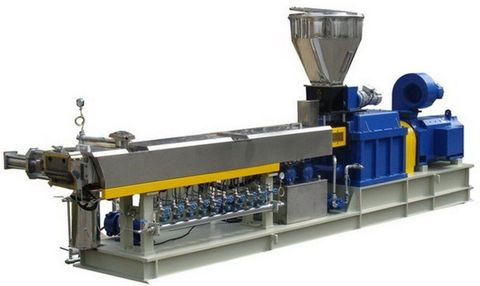
The PVC pipe extrusion machine is the central component in many pipe manufacturing lines.
In extrusion, PVC compound enters the extruder through a feeding system. Heat and mechanical action help process the material before it moves through a die.
The die and mandrel create the basic tubular shape.
Single-screw and twin-screw extruders are both used in PVC processing. BIS manufacturing documentation explains that single-screw systems can be used for smaller pipe applications, while twin-screw systems can provide greater blending and productivity capabilities for larger sizes and thicknesses.
Important extrusion parameters can include:
Barrel temperature
Screw speed
Melt pressure
Material feed rate
Die temperature
Cooling conditions
Haul-off speed
Maintaining stable process conditions is important because changes in extrusion parameters can influence wall thickness, dimensions, surface appearance, and overall consistency.
Automatic PVC Pipe Making Machine
An automatic PVC pipe making machine generally refers to equipment in which several production functions are controlled through automated systems.
Depending on the configuration, automation may coordinate:
Material feeding
Temperature control
Extruder operation
Vacuum sizing
Cooling
Haul-off speed
Cutting length
Alarm systems
Production monitoring
Modern control systems may use programmable logic controllers, sensors, digital displays, and variable-frequency drives.
Automation does not eliminate the need for operators. Personnel may still be required for machine setup, material preparation, inspection, cleaning, maintenance, troubleshooting, and process supervision.
PVC Pipe Forming Machine and Sizing
The term PVC pipe forming machine can refer to the equipment and tooling responsible for shaping extruded material into the required tubular geometry.
Immediately after extrusion, the hot pipe needs controlled sizing and cooling.
A vacuum sizing tank helps establish the required outside dimensions. The pipe then moves through cooling equipment where its temperature decreases and the material becomes sufficiently rigid for subsequent handling.
The relationship between extrusion speed, vacuum pressure, cooling conditions, and haul-off speed is important.
A simplified process relationship is:
Stable extrusion + controlled sizing + consistent cooling + regulated haul-off = dimensional consistency
This is why the individual machines within a production line should be considered as an integrated system rather than isolated equipment.
PVC Pipe Cutting Machine
The PVC pipe cutting machine is normally positioned downstream from the extrusion and cooling stages.
Its purpose is to cut continuous pipe into predetermined lengths.
Common considerations include:
Required cutting length
Pipe diameter
Wall thickness
Cutting speed
Blade or cutting mechanism
Automatic length measurement
Pipe alignment
Dust or chip management
In continuous extrusion, the cutting system needs to coordinate with the movement of the pipe. BIS documentation notes that the cutter platform can move with the extruded pipe so that cutting does not interrupt the extrusion process.
Factors That Influence Machine Selection
Selecting equipment requires more than looking at a machine's headline capacity.
Important factors include:
| Factor | What to Evaluate |
|---|---|
| Pipe diameter | Minimum and maximum sizes |
| Wall thickness | Required production range |
| PVC formulation | Material characteristics and additives |
| Extruder | Screw configuration and processing range |
| Die tooling | Available sizes and changeover requirements |
| Cooling | Tank dimensions and water circulation |
| Haul-off | Traction control and speed range |
| Cutting | Length accuracy and cutting method |
| Automation | PLC, sensors, alarms and controls |
| Factory space | Complete line footprint |
| Utilities | Electrical, water and compressed-air requirements |
The intended application should be identified before selecting tooling and process equipment.
A pipe intended for potable water, drainage, electrical protection, or irrigation can have different technical requirements.
Recent Developments in PVC Pipe Manufacturing
PVC processing technology continues to move toward greater automation, monitoring, energy management, and process consistency.
Modern production lines increasingly use:
Digital temperature controllers
Automated material feeding
Variable-speed drives
Sensor-based monitoring
Automatic length measurement
Centralized control panels
Production data logging
Automated alarms
Improved cooling management
More precise extrusion controls
Another important development is greater attention to material efficiency. Stable process control can help manufacturers maintain required dimensions while reducing unnecessary material variation.
India's standards environment also continues to be reviewed. BIS records show that IS 4985:2021, covering unplasticized PVC pipes for potable water supplies, was reviewed in 2026. The standard is classified under PVC pipes, fittings, and testing.
BIS also records IS 13592:2013 for PVC-U pipes used for soil and waste discharge systems, as well as IS 12818:2010 for PVC-U screen and casing pipes used in bore and tubewells.
These standards demonstrate that pipe specifications vary according to application.
Indian Standards and Quality Considerations
Manufacturers need to identify the applicable Indian Standard for the particular type of pipe being produced.
For potable-water applications, BIS identifies IS 4985:2021 — Unplasticized PVC Pipes for Potable Water Supplies — Specification. Its BIS product manual provides information concerning raw materials, testing, sampling, and conformity assessment.
BIS's current database records the standard as reviewed in 2026.
Other PVC pipe applications have different standards.
Examples include:
IS 4985 for potable-water PVC-U pipes
IS 13592 for soil and waste discharge systems
IS 12818 for bore and tubewell screen and casing pipes
IS 15328 for underground drainage and sewerage applications
Therefore, a machine configuration should be considered together with the pipe specification, material formulation, dimensions, and testing requirements.
Laws, Policies, and Environmental Considerations in India
PVC pipe manufacturing is affected by environmental and waste-management requirements in addition to product standards.
India's Solid Waste Management Rules, 2026 were notified on 27 January 2026 and came into force on 1 April 2026. The Central Pollution Control Board states that the framework establishes responsibilities for different stakeholders and introduces requirements including source segregation and waste-management reporting.
Manufacturing facilities should therefore consider how production scrap, packaging waste, rejected pipes, and other materials are collected, stored, reused, or transferred.
The broader plastic-waste framework has also continued to evolve. CPCB's Plastic Waste Management portal lists amendments through 2026, including updates to the Plastic Waste Management Rules and Extended Producer Responsibility framework.
A 2025 CPCB notice also addressed registration requirements for specified manufacturers and importers of plastic raw materials and certain other entities on the centralized EPR portal.
The exact obligations depend on the nature of the facility and materials involved, so manufacturers should verify the latest requirements with the relevant CPCB, State Pollution Control Board, BIS, and local authorities.
Energy, Water, and Factory Planning
PVC pipe production requires electrical energy, cooling water, material-handling systems, and adequate factory space.
A basic factory-planning checklist can include:
Electrical load assessment
Cooling-water circulation
Water-treatment arrangements where required
Ventilation
Raw-material storage
Finished-pipe storage
Machine foundations
Operator access
Emergency access
Fire-safety provisions
Waste collection areas
Quality-testing space
Cooling is particularly important because the pipe must be stabilized after extrusion before cutting and handling.
Efficient water circulation and monitoring can help reduce unnecessary resource use in the production process.
Useful Tools and Resources
Several resources can help with PVC pipe manufacturing research.
BIS Standards Database: Useful for identifying applicable Indian Standards, revisions, amendments, and product specifications.
BIS Product Manuals: Helpful for understanding conformity assessment, sampling, raw materials, testing, and production-related requirements.
CPCB Plastic Waste Portal: Provides information about plastic-waste management, EPR developments, reporting, and related regulatory information.
CPCB Solid Waste Management Portal: Provides information about the Solid Waste Management Rules, 2026 and associated responsibilities.
Production calculation spreadsheet: Useful for comparing pipe diameter, wall thickness, line speed, operating hours, and expected output.
Machine-maintenance checklist: Can track lubrication, heaters, screws, dies, vacuum pumps, cooling systems, haul-off units, cutters, sensors, and electrical components.
Practical Production-Line Checklist
Before operating a PVC pipe production line, manufacturers can review:
Correct PVC formulation
Appropriate die and mandrel
Extruder temperature settings
Material feed consistency
Vacuum sizing conditions
Cooling-water temperature
Haul-off speed
Cutting length
Surface appearance
Pipe dimensions
Wall thickness
Batch identification
Quality-test records
Waste collection
Machine safety systems
Regular monitoring can help identify process deviations before they affect a larger quantity of finished pipe.
Frequently Asked Questions
What is a PVC pipe manufacturing machine?
It is industrial equipment used to process PVC compounds into pipes. A complete system can include an extruder, die, sizing tank, cooling tank, haul-off unit, cutting machine, and stacking or handling equipment.
What does a PVC pipe extrusion machine do?
It heats and processes PVC compound and pushes the material through a die and mandrel to create the basic tubular pipe shape. The pipe is then sized, cooled, hauled, and cut.
What is the purpose of a PVC pipe cutting machine?
It cuts continuously extruded pipe into predetermined lengths. Automated cutting systems can coordinate the cutting process with pipe movement.
Which Indian Standard applies to PVC water pipes?
For unplasticized PVC pipes intended for potable-water supplies, BIS identifies IS 4985:2021. The standard was reviewed in 2026.
Can one PVC pipe production line manufacture every pipe type?
Not necessarily. Pipe diameter, wall thickness, material formulation, application, tooling, and applicable specifications can differ. A production line should therefore be configured for the intended range of products.
Conclusion
PVC pipe manufacturing machines form an integrated production system in which material preparation, extrusion, forming, sizing, cooling, hauling, cutting, and inspection work together.
The PVC pipe extrusion machine is generally the central processing unit, while the PVC pipe forming machine, vacuum sizing equipment, cooling systems, haul-off units, and PVC pipe cutting machine perform supporting roles.
Recent developments have placed greater emphasis on automation, process monitoring, material efficiency, and regulatory compliance. India's standards database also shows continued review of important PVC pipe standards, including IS 4985:2021 in 2026.
Environmental management is another important consideration. The Solid Waste Management Rules, 2026 and continuing developments under India's plastic-waste framework make responsible handling of manufacturing waste increasingly relevant.
For anyone researching automatic PVC pipe making machines, the most useful approach is to evaluate the complete production process rather than focusing on one machine. Pipe specifications, tooling, extrusion conditions, cooling, cutting accuracy, quality testing, factory requirements, and applicable Indian Standards should all be considered together.
Disclaimer: This article is provided for general informational and educational purposes only. It does not constitute technical, legal, regulatory, financial, or professional advice. We do not claim that any particular machine, manufacturer, specification, production method, or regulatory interpretation is suitable for a specific application. Readers should verify current requirements with the relevant authorities, standards organizations, qualified technical professionals, and equipment documentation before making decisions. This article is intended only to provide information and does not sell, promote, endorse, or recommend any product, machine, manufacturer, or organization.

Related Post...
Industrial Flour Packing Machines: Explore Guide, Tips, Insights, Advice, and Expert Suggestions
Updated: October 27, 2026
Read More