Ruby Jewellery Collection: Complete Guide to Basics, Designs, Facts, Knowledge, and Best Practices
A ruby jewellery collection includes jewellery pieces featuring rubies, a red variety of the mineral corundum. Rubies are valued for their colour, durability, rarity, and long association with traditional and contemporary jewellery.
Their colour can range from pinkish red to deep red. The presence of chromium gives rubies their characteristic colour, while other trace elements and geological conditions can influence their appearance.
Rubies are used in several jewellery forms, including rings, necklaces, earrings, pendants, bracelets, and complete sets. They can be mounted in yellow gold, white gold, platinum, or combined with diamonds and other gemstones.
The term ruby jewellery designs covers a wide range of styles. Traditional Indian designs may feature detailed gold work, floral arrangements, and gemstone clusters, while modern designs often use simpler settings that highlight the ruby itself.
Understanding gemstone characteristics, metal quality, treatments, and jewellery construction helps people interpret the differences between various ruby pieces.
Why Ruby Jewellery Remains Important
Rubies have a long history in jewellery traditions across Asia, Europe, and other regions. In India, red gemstones are frequently associated with traditional ornaments, ceremonial clothing, and heritage jewellery.
Today, ruby jewellery is relevant to several areas:
Traditional and bridal jewellery
Contemporary gemstone jewellery
Personal collections
Family heirlooms
Cultural and festive ornaments
Custom jewellery design
Gemstone education and research
Rubies are also relatively durable. On the Mohs scale of mineral hardness, corundum has a hardness of 9, making ruby suitable for many jewellery applications. However, hardness does not mean that a ruby cannot chip or become damaged.
The popularity of ruby jewellery also reflects interest in coloured gemstones as alternatives to jewellery dominated by diamonds.
Understanding Natural Ruby Jewellery
Natural ruby jewellery contains rubies formed through geological processes rather than stones created entirely in a laboratory.
Natural rubies can differ in:
Colour
Transparency
Clarity
Crystal structure
Inclusions
Origin
Treatment history
Cut and proportions
Some natural rubies contain visible internal characteristics known as inclusions. These may help gemologists understand a stone's formation and distinguish it from other materials.
Natural rubies can also undergo treatments to improve their appearance. Heat treatment is widely used in the gemstone industry, while other treatments may involve filling fractures or modifying surface characteristics.
For this reason, the word "natural" alone does not describe the complete condition of a gemstone. Treatment information and reliable gemological documentation are important when assessing a particular stone.
Popular Ruby Jewellery Designs
Ruby jewellery is available in traditional, contemporary, and fusion styles. The choice of design depends on the intended occasion, clothing, personal preferences, and gemstone characteristics.
| Jewellery Type | Common Design Features | Typical Use |
|---|---|---|
| Ruby necklace | Ruby clusters, floral patterns, or single-stone arrangements | Weddings and formal occasions |
| Ruby earrings | Studs, drops, hoops, and chandelier patterns | Daily and occasion wear |
| Ruby pendant | Single ruby or ruby-diamond combination | Everyday and formal wear |
| Ruby ring | Solitaire, halo, or cluster settings | Personal and ceremonial jewellery |
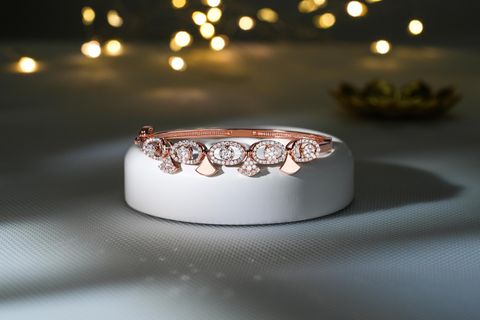
| Ruby bracelet | Repeated gemstone patterns or linked settings | Festive and formal wear |
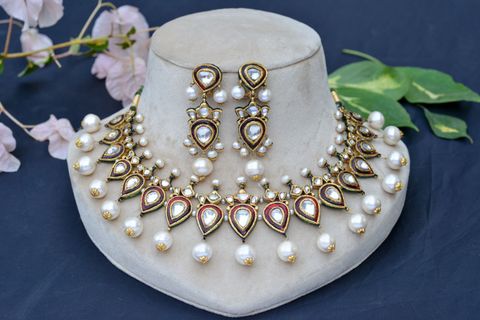
| Ruby jewellery set | Coordinated necklace, earrings, and sometimes a ring | Weddings and celebrations |
Traditional designs often use multiple stones in symmetrical arrangements. Contemporary designs may emphasize a single ruby with a minimal metal setting.
Ruby Gold Jewellery
Ruby gold jewellery combines red gemstones with gold settings. Yellow gold is a traditional choice because its warm colour creates a strong contrast with red rubies.
Common design approaches include:
Ruby floral arrangements in yellow gold
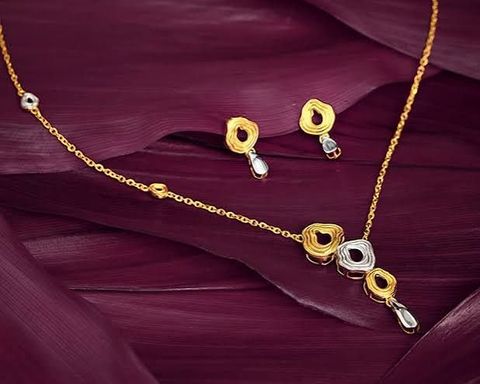
Gold necklaces with ruby drops
Ruby-studded traditional earrings
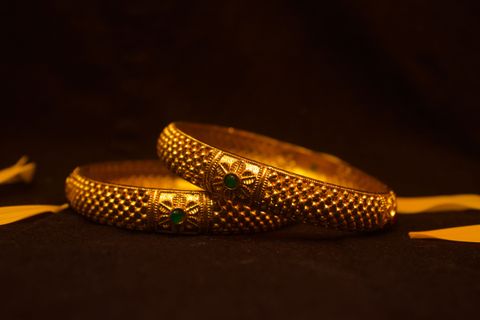
Gold bangles with ruby accents
Ruby pendants with decorative gold borders
Multi-stone gold jewellery sets
Gold purity is generally described in karats. Common jewellery grades include 18K and 22K gold, although the appropriate alloy depends on the design and construction.
Higher-purity gold is generally softer than lower-purity gold alloys. Therefore, jewellery designers consider the intended use, setting strength, and gemstone security when selecting the metal composition.
Ruby Diamond Jewellery
Ruby diamond jewellery combines two different gemstones to create contrast in colour, brilliance, and visual texture.
Diamonds may be arranged around a central ruby or placed in patterns alongside several smaller rubies.
Common arrangements include:
Ruby surrounded by a diamond halo
Alternating ruby and diamond patterns
Ruby centre stones with diamond side stones
Floral ruby-diamond pendants
Diamond-accented ruby earrings
Geometric gemstone necklaces
Diamonds can reflect light strongly, while rubies provide a distinct red colour. The balance between the two depends on stone size, cut, setting, and overall design.
Ruby Necklace Designs and Jewellery Sets
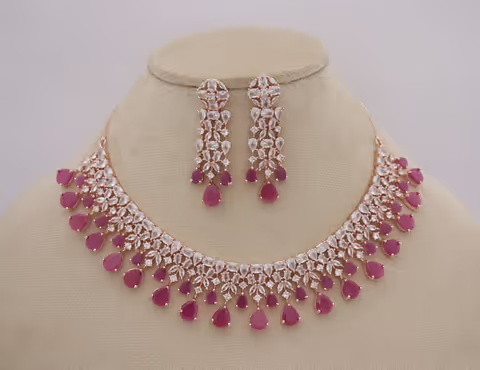
Ruby necklace designs range from simple pendants to elaborate necklaces containing multiple gemstones.
Some common categories include:
Solitaire ruby necklaces
Ruby and diamond necklaces
Traditional gold necklaces with ruby accents
Floral ruby necklaces
Layered gemstone necklaces
Choker-style ruby necklaces
Contemporary geometric designs
A ruby jewellery set may include a necklace and matching earrings, with some collections also containing bracelets or rings.
When selecting coordinated pieces, examine whether the stones have similar colour characteristics. Rubies can vary naturally, so matching stones may not have perfectly identical shades.
Understanding Ruby Quality
Gemstone evaluation involves several characteristics. Unlike diamonds, coloured gemstones do not have one universally applied grading system that determines every aspect of quality.
The main factors include:
| Factor | What It Describes |
|---|---|
| Colour | Hue, tone, and saturation of red |
| Clarity | Visibility and type of internal characteristics |
| Cut | Shape, proportions, and light reflection |
| Carat weight | Gemstone weight |
| Origin | Geographic source, when reliably established |
| Treatment | Any process used to alter appearance |
| Transparency | How clearly light passes through the stone |
Colour is often a particularly important characteristic when evaluating rubies. However, a bright red appearance alone does not establish whether a stone is natural, untreated, or from a particular geographic location.
Recent Developments in Coloured Gemstone Jewellery
Interest in coloured gemstones has continued to receive attention across the jewellery industry during 2026.
On 13 January 2026, the Gem and Jewellery Export Promotion Council reported a discussion on improving transparency and standardization in coloured gemstone valuation. The discussion highlighted the importance of colour, clarity, cut, carat weight, origin, treatment, and international certification when assessing gemstones. (GJEPC)
On 2 July 2026, an industry discussion published by JewelleryNet described increasing interest in coloured gemstones, including rubies, sapphires, and emeralds, as alternatives to conventional diamond-focused designs. (JewelleryNet)
These developments reflect several broader design directions:
Greater attention to coloured gemstones
More individual and personalized designs
Combinations of rubies with diamonds
Contemporary settings for traditional gemstones
Increased interest in gemstone documentation
More discussion of treatment and origin disclosure
These are industry observations rather than guarantees about future demand or gemstone values.
Laws and Policies Affecting Ruby Jewellery in India
Ruby jewellery can involve two different regulatory considerations: precious-metal purity and gemstone identification.
In India, the Bureau of Indian Standards (BIS) operates the hallmarking framework for gold and silver jewellery. Hallmarking provides information about the precious-metal purity and identification of qualifying articles. It does not independently certify the natural origin, treatment, or geographic source of a ruby.
The BIS hallmark on qualifying gold jewellery includes:
BIS Standard Mark
Gold purity in caratage and fineness
Six-digit alphanumeric Hallmark Unique Identification Number (HUID)
Consumers can use the BIS Care application to verify HUID details for hallmarked gold jewellery. (BIS Hallmarking FAQs)
There were further developments during 2026. The government issued amendments to the Hallmarking of Gold Jewellery and Gold Artefacts Order on 2 March 2026, 28 April 2026, and 3 August 2026. These amendments updated the district coverage annexure under the hallmarking framework. (BIS Mandatory Hallmarking Order)
For ruby jewellery, it is useful to distinguish between:
Gold hallmarking, which concerns the purity of the gold
Gemstone identification, which concerns the stone's identity
Treatment disclosure, which concerns any enhancement process
Origin reporting, which concerns the geographical source when established
A gemological report from a recognized laboratory may provide information about a gemstone's identity and certain treatments. The exact scope depends on the laboratory and report type.
Tools and Useful Resources
Several resources can help people understand ruby jewellery and gemstone characteristics.
Bureau of Indian Standards: Useful for information about gold hallmarking, HUID verification, and precious-metal standards. (BIS)
BIS Care App: Helps verify the HUID details of qualifying hallmarked gold jewellery.
Gemological Institute of America (GIA): Provides educational information about ruby characteristics, treatments, identification, and gemstone reports. (GIA)
Gem and Jewellery Export Promotion Council: Publishes Indian jewellery-industry information, gemstone discussions, and market developments. (GJEPC)
Gemstone comparison worksheet: A spreadsheet can record colour, weight, dimensions, treatment disclosures, laboratory documentation, and setting details.
Jewellery inspection checklist: Useful for recording metal purity marks, gemstone condition, clasp strength, prong security, and general workmanship.
Best Practices for Ruby Jewellery Care
Rubies are durable gemstones, but their care depends on the stone's treatment, setting, and surrounding materials.
Recommended practices include:
Store ruby jewellery separately from softer gemstones.
Use a soft cloth to remove surface dust.
Avoid harsh chemicals and household cleaners.
Inspect prongs and gemstone settings periodically.
Keep jewellery away from unnecessary impacts.
Follow laboratory or jeweller guidance for treated stones.
Avoid ultrasonic or steam cleaning unless suitability is confirmed.
Store necklaces and bracelets in separate compartments.
Keep gemstone reports and jewellery documentation safely.
For pieces containing both rubies and diamonds, cleaning methods should be suitable for every material and the metal setting.
Frequently Asked Questions
What is included in a ruby jewellery collection?
A ruby jewellery collection can include necklaces, earrings, rings, pendants, bracelets, bangles, and coordinated jewellery sets featuring rubies.
How can natural ruby jewellery be identified?
Visual inspection alone cannot reliably establish whether a ruby is natural, synthetic, or treated. A qualified gemologist or suitable laboratory report can provide more dependable identification.
What is the difference between ruby gold jewellery and ruby diamond jewellery?
Ruby gold jewellery combines rubies with gold settings, while ruby diamond jewellery combines rubies and diamonds in the same design. Some pieces use all three materials.
Are rubies suitable for everyday jewellery?
Rubies have a Mohs hardness of 9, making them suitable for many jewellery applications. However, everyday pieces still require secure settings and appropriate care to reduce the risk of damage.
Does a BIS hallmark confirm that a ruby is natural?
No. A BIS hallmark indicates information about the purity of qualifying precious-metal jewellery. It does not independently confirm the ruby's natural origin, treatment history, or geographic source.
Conclusion
A ruby jewellery collection brings together gemstone characteristics, metal craftsmanship, cultural traditions, and contemporary design. From natural ruby jewellery and ruby gold jewellery to ruby diamond jewellery, the available styles range from simple everyday pieces to elaborate necklaces and coordinated sets.
Understanding colour, clarity, cut, treatment, origin, and metal purity can help readers interpret the differences between ruby jewellery designs. Indian hallmarking rules also provide an important framework for checking the purity of qualifying gold jewellery, although gemstone identification requires separate documentation.
Recent 2026 industry discussions show continued attention to coloured gemstones, gemstone transparency, and contemporary design approaches. These developments make gemstone education and careful documentation especially relevant.
Disclaimer: This article is intended solely for general informational and educational purposes. It does not claim to provide gemstone authentication, professional gemological advice, financial guidance, or a guarantee about the quality, origin, treatment, or value of any jewellery. We do not sell, promote, or endorse any jewellery, gemstone, brand, manufacturer, or retailer mentioned or discussed. Readers should consult qualified gemologists, recognized laboratories, and relevant official authorities when they require verification or professional guidance.

Related Post...
Ruby Jewellery Collection: Complete Guide to Basics, Designs, Facts, Knowledge, and Best Practices
Updated: November 04, 2026
Read More
Lab Grown Diamond Jewellery: Explore Overview, Basics, Explanation, Knowledge, and Key Details
Updated: November 04, 2026
Read More
Traditional Jhumka Designs: Complete Guide to Basics, Designs, Facts, Knowledge, and Best Practices
Updated: November 04, 2026
Read More