Seed Drill Machines: Explore Types, Features, Applications, and Useful Resources
Sowing is one of the most important stages of crop production. The placement of seeds at the correct depth, spacing, and row distance can influence germination, plant growth, and field productivity. A seed drill machine is agricultural equipment designed to place seeds into the soil in organised rows at controlled depths and intervals.
Unlike broadcasting, where seeds are spread over the field surface, a seed drill places seeds through delivery tubes and opener mechanisms. Many machines also cover the seeds with soil and may include a fertiliser application arrangement.
An agricultural seed drill can be operated manually, attached to a tractor, or pulled by a tractor, depending on its design and capacity. Modern machines may include adjustable seed metering systems, electronic monitoring, GPS guidance, and variable-rate technology.
This guide explains seed drill machine types, components, working principles, applications, recent developments, Indian agricultural policies, and best practices.
Understanding Seed Drill Machines
A seed drill is a sowing implement that places seeds into prepared or minimally disturbed soil according to selected planting settings. It is designed to distribute seeds in rows while maintaining suitable depth and spacing.
The machine generally performs several operations:
Seed storage: Holds seeds in a hopper before sowing.
Seed metering: Controls the quantity of seed released.
Seed delivery: Transfers seeds through tubes towards the soil.
Furrow opening: Creates narrow channels in the soil.
Seed placement: Deposits seeds at the selected depth.
Soil covering: Covers the seeds with soil after placement.
Soil pressing: Some designs use press wheels to improve seed-to-soil contact.
A seed drill may also have a fertiliser box and separate delivery system. This allows fertiliser to be placed alongside or near the seed according to the crop's agronomic requirements.
Importance of Seed Drill Machines
Seed drill machines support organised sowing and can improve the consistency of seed placement.
Uniform seed distribution: Metering systems help maintain consistent seed placement along rows.
Controlled sowing depth: Adjustable openers help place seeds at a suitable depth.
Row spacing: The machine maintains defined distances between planting rows.
Reduced seed wastage: Controlled metering can reduce excessive seed application compared with less controlled broadcasting methods.
Efficient field operations: Tractor-operated machines can cover larger areas in less time than manual sowing.
Fertiliser placement: Some models combine seed placement with fertiliser application.
Improved field management: Organised rows can make later operations such as weeding, irrigation, and crop monitoring easier.
Actual results depend on seed quality, soil preparation, moisture, machine calibration, crop requirements, and operating conditions.
Main Types of Seed Drill Machines
Seed drill machines are classified according to their power source, mounting arrangement, seed-metering mechanism, and field application.
1. Tractor Mounted Seed Drill
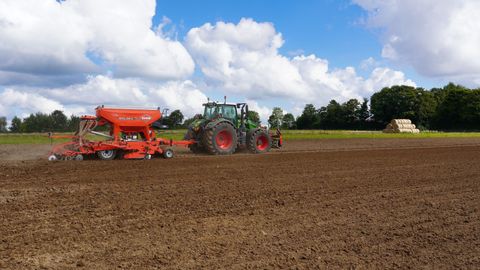
A tractor mounted seed drill is attached directly to the tractor's three-point linkage. The tractor lifts and carries the implement during transport and provides the power needed for field operation.
Common features include:
Rigid frame and mounting points
Seed and optional fertiliser boxes
Multiple furrow openers
Ground-wheel-driven or other metering arrangements
Adjustable sowing depth and row spacing
This type is commonly used for sowing wheat, pulses, and other crops in prepared fields.
2. Tractor Operated Seed Drill
A tractor operated seed drill uses a tractor as its power source. It may be mounted or trailed, depending on the machine design.
It is suitable for medium and large agricultural fields. Its working width, row count, hopper capacity, and opener arrangement determine the field coverage and crop suitability.
3. Tractor Drawn Seed Drill
A tractor drawn seed drill is pulled behind a tractor through a drawbar or suitable hitch. It generally runs on its own transport or ground wheels while the tractor provides forward movement.
Typical characteristics include:
Trailed frame arrangement
Multiple seed outlets
Ground-driven metering on many designs
Suitable configurations for larger fields
Separate seed and fertiliser delivery on selected models
4. Small Farm Seed Drill
A small farm seed drill is designed for smaller agricultural plots and relatively limited field operations. It may be operated with a compact tractor, power tiller, or another suitable power source.
It generally has a narrower working width and fewer rows than larger tractor-operated models.
5. Mini Seed Drill Machine
A mini seed drill machine is a compact sowing implement intended for small plots, garden-scale cultivation, and selected field crops. Depending on the design, it may be manually operated or connected to a power tiller or compact tractor.
Its suitability depends on seed size, soil condition, row spacing, and the available metering arrangement.
6. Zero-Till Seed Drill
A zero-till seed drill places seeds directly into untilled soil, often through crop residues left after the previous harvest. Its specialised furrow openers create narrow slots for seed placement.
ICAR describes tractor-operated zero-till seed-cum-fertiliser drills developed for sowing wheat directly in rice-harvested fields without conventional seedbed preparation.
7. Seed-Cum-Fertiliser Drill
This machine has separate boxes and metering arrangements for seeds and fertiliser. It places both materials during the same field pass, with the placement pattern designed to reduce direct seed-fertiliser contact where required.
Main Components of an Agricultural Seed Drill
The construction of a seed drill varies according to its type and capacity, but most models contain the following parts.
Component | Main function |
|---|---|
Main frame | Supports the machine and its working components |
Seed box | Stores seeds before sowing |
Fertiliser box | Holds fertiliser in combined models |
Seed metering unit | Controls the quantity of seed released |
Seed tubes | Carry seeds towards the furrow openers |
Furrow openers | Create channels in the soil |
Depth-control wheels | Help maintain the selected sowing depth |
Covering arrangement | Covers seeds with soil |
Press wheels | Improve seed-to-soil contact in selected designs |
Ground wheel | Drives the metering mechanism on many machines |
Hitch or linkage | Connects the implement to the tractor or power source |
Adjustment mechanism | Regulates seed rate, spacing, and other settings |
Seed Drill Machine Working Principle
A seed drill uses forward movement and a metering mechanism to distribute seeds through delivery tubes into prepared furrows.
On many tractor-operated models, a ground wheel drives the seed-metering shaft through a chain, sprocket, or gear arrangement. As the machine moves, the metering mechanism releases seeds at a controlled rate.
The typical working sequence is:
Fill the seed box with clean, suitable seed.
Set the required seed rate and row spacing.
Adjust the furrow openers to the recommended planting depth.
Attach the implement securely to the tractor or power source.
Move the machine forward at a suitable operating speed.
Allow the metering system to release seeds into the delivery tubes.
Guide seeds through the tubes into the open furrows.
Cover the seeds with soil using the covering mechanism.
Use press wheels where fitted to improve soil contact.
Inspect the field to verify seed placement and distribution.
The machine should be calibrated before sowing because seed size, shape, density, and metering-system design can affect the quantity delivered.
Seed Metering Technologies
The metering mechanism is one of the most important parts of a seed drill. It determines how seeds are released and distributed.
Fluted Roller Metering
A fluted roller uses grooves along its surface to collect and release seeds. Changing the exposed roller length or setting can adjust the quantity delivered.
Cell or Plate Metering
A rotating plate with specially designed cells or openings picks up seeds and releases them at intervals. This arrangement is used in selected planters and precision sowing equipment.
Pneumatic Metering
Pneumatic systems use controlled airflow to move or distribute seeds. Depending on the design, they can support accurate placement and multi-row sowing.
Electronic Seed Monitoring
Electronic sensors can detect seed flow through individual delivery tubes. They may alert the operator when a row is blocked or when seed flow becomes irregular.
Applications of Seed Drill Machines
Seed drills are used for sowing different crops according to their seed size, planting depth, row spacing, and soil requirements.
Crop or application | Typical use |
|---|---|
Wheat | Line sowing in prepared or untilled fields |
Barley | Row-based sowing with controlled seed distribution |
Pulses | Planting crops such as chickpea and lentil |
Soybean | Placing seeds at suitable depth and spacing |
Sorghum | Sowing grain and fodder varieties |
Maize | Row planting with compatible metering arrangements |
Mustard | Controlled seed placement |
Oats | Sowing grain and fodder crops |
Groundnut | Planting with suitable seed-metering and opener systems |
A machine should be selected according to the crop and seed characteristics. Small seeds, large seeds, and irregularly shaped seeds may require different metering arrangements.
Recent Developments and Industry Trends
Agricultural sowing equipment is evolving through precision farming, improved seed-metering systems, conservation agriculture, and digital monitoring.
Precision Seed Placement
Modern seed drills increasingly use improved metering systems to regulate seed quantity, row spacing, and placement depth. Precision placement can help create more uniform crop stands when soil and seed conditions are suitable.
Zero-Till and Conservation Agriculture
Zero-till drills are used to establish crops without conventional seedbed preparation. They can place seeds through suitable crop residues and reduce the number of field operations. ICAR's farm machinery programme documents tractor-operated zero-till seed-cum-fertiliser drills for direct wheat sowing after rice harvesting.
GPS and Digital Guidance
GPS-based guidance systems help tractors follow planned field paths and maintain consistent row alignment. They are particularly useful in larger fields and repeated field operations.
Electronic Seed Monitoring
Sensors installed near seed delivery tubes can monitor seed flow and identify blocked outlets or irregular distribution. This helps operators detect problems during sowing.
Improved Small-Farm Mechanisation
Compact drills and power-tiller-operated sowing implements are being developed for smaller agricultural holdings. These machines support mechanised sowing where larger tractor-mounted equipment may not be suitable.
Shared Agricultural Machinery
Custom Hiring Centres and Farm Machinery Banks are expanding access to agricultural implements. India's Sub-Mission on Agricultural Mechanization supports machinery access, testing, demonstrations, and shared-use arrangements. A Ministry of Agriculture update published on August 11, 2026 described continued support under the programme.
Laws, Policies, and Standards in India
Seed drill machines in India are covered by agricultural machinery standards, testing procedures, and government mechanisation programmes. Farmers and manufacturers should check the latest applicable requirements before selecting, manufacturing, or operating equipment.
BIS Standard IS 6813:2000
The Bureau of Indian Standards identifies IS 6813:2000 as the specification for seed-cum-fertiliser drills. It covers material, construction, performance, and other requirements for animal-drawn and tractor-operated machines, including mounted and trailed arrangements.
BIS Standard IS 6316:1993
IS 6316:1993 is the test code for seed-cum-fertiliser drills. It provides a basis for evaluating the performance of this agricultural sowing equipment. The Southern Region Farm Machinery Training and Testing Institute lists this standard among its agricultural machinery testing references.
Sub-Mission on Agricultural Mechanization
The Sub-Mission on Agricultural Mechanization (SMAM), implemented under the Rashtriya Krishi Vikas Yojana framework, promotes access to agricultural machinery through individual assistance, Custom Hiring Centres, and Farm Machinery Banks.
The Ministry of Agriculture's August 11, 2026 update describes financial assistance for eligible machinery purchases and support for shared machinery facilities. Assistance rates and eligibility depend on current scheme guidelines and state-level implementation.
Agricultural Machinery Testing
Farm Machinery Training and Testing Institutes evaluate agricultural equipment according to relevant testing procedures. The testing process may examine construction, seed distribution, field performance, operational safety, and other machine characteristics.
The Southern Region Farm Machinery Training and Testing Institute lists seed-cum-fertiliser drills among the equipment categories covered by its testing information.
Agricultural Recommendations
ICAR and State Agricultural Universities publish crop-specific sowing recommendations, including seed rate, row spacing, sowing depth, and suitable machinery. These recommendations vary by crop variety, region, soil, and growing season. For example, ICAR's 2025 Kharif advisory emphasised proper seed-drill calibration and suitable row spacing for line-sown paddy in the relevant regional guidance.
Best Practices for Operating Seed Drill Machines
Proper calibration, maintenance, and field preparation help maintain accurate seed placement.
Select suitable equipment: Match the machine to the crop, seed size, field area, soil condition, and available tractor power.
Check seed quality: Use clean, properly graded seeds that are suitable for the selected metering system.
Calibrate before sowing: Measure the seed output and adjust the metering mechanism to achieve the recommended seed rate.
Set the correct depth: Follow crop-specific sowing recommendations rather than using one depth for every crop.
Check row spacing: Adjust furrow openers according to the crop's planting requirements.
Inspect seed tubes: Remove blockages and check for damage before beginning field operations.
Maintain uniform speed: Avoid sudden speed changes that may affect seed distribution.
Prepare the field appropriately: Ensure soil conditions are suitable for the selected drill and crop.
Check seed placement: Stop periodically and inspect seed depth, spacing, and covering.
Maintain the metering system: Clean rollers, plates, tubes, chains, and other moving parts after use.
Inspect the frame and openers: Check for loose fasteners, worn components, and damaged furrow openers.
Store the machine properly: Remove leftover seed and fertiliser, clean the implement, and protect metal parts from corrosion.
Tools and Resources for Seed Drill Operations
Several agricultural tools and technical resources support seed drill selection, calibration, and field management.
Tool or resource | Purpose |
|---|---|
Seed-rate calculator | Estimates seed quantity required for a given field area |
Seed calibration tray | Collects and measures seed output during calibration |
Measuring tape | Checks row spacing and machine dimensions |
Soil moisture meter | Helps assess soil moisture conditions |
GPS guidance system | Supports accurate tractor movement |
Seed flow sensors | Monitor seed delivery through individual tubes |
Tractor power calculator | Helps match implement requirements with tractor capacity |
Agricultural extension publications | Provide crop-specific sowing recommendations |
ICAR resources | Provide research-based agricultural machinery information |
BIS standards catalogue | Helps identify relevant Indian machinery standards |
Farm machinery testing institutes | Provide equipment testing and performance information |
Frequently Asked Questions
1. What is a seed drill machine?
A seed drill machine is agricultural equipment that places seeds into the soil in organised rows at controlled depths and intervals. Some models also apply fertiliser during the same operation.
2. What is the difference between a tractor mounted and tractor drawn seed drill?
A tractor mounted seed drill is connected directly to the tractor's three-point linkage and is lifted during transport. A tractor drawn seed drill is pulled behind the tractor through a suitable hitch and generally runs on its own supporting wheels.
3. What is a mini seed drill machine used for?
A mini seed drill machine is designed for smaller plots and selected sowing applications. Depending on its configuration, it can be manually operated or connected to a power tiller or compact tractor.
4. Which crops can be sown using an agricultural seed drill?
Depending on the metering system and furrow opener arrangement, seed drills can be used for wheat, barley, pulses, soybean, sorghum, oats, mustard, and other crops.
5. Why is seed drill calibration important?
Calibration determines how much seed the machine releases over a given area. Correct calibration helps maintain the recommended seed rate, avoid excessive or insufficient sowing, and achieve more uniform crop establishment.
Conclusion
Seed drill machines are important agricultural implements that help place seeds at controlled depths and row spacings. Different configurations, including tractor mounted seed drills, tractor drawn seed drills, small farm seed drills, mini seed drill machines, and zero-till drills, support different crops and field conditions.
Modern developments in precision metering, GPS guidance, electronic monitoring, and conservation agriculture continue to improve sowing equipment. Understanding machine components, seed-metering systems, calibration methods, Indian standards, and crop-specific recommendations helps farmers use seed drills effectively.
Disclaimer: This article is intended for general informational and educational purposes only. Machine specifications, crop suitability, sowing recommendations, government schemes, and regulatory requirements should be verified with qualified agricultural professionals and relevant authorities before practical application. No particular machine, product, brand, or organisation is guaranteed or endorsed.

Related Post...
Pasta Making Machines: Explore Types, Features, Applications, and Useful Resources
Updated: November 16, 2026
Read More
CO2 Laser Cutting Machines: Explore Overview, Basics, Explanation, Knowledge, and Key Details
Updated: November 17, 2026
Read More
MIG Welding Machines: Explore Overview, Basics, Explanation, Knowledge, and Key Details
Updated: November 17, 2026
Read More